In this guide
- 01What Noh is, briefly
- 02The formats — the real decision
- 03The hayashi
- 04The mask
- 05The five categories
- 06The schools, as context
- 07What a first viewing asks of you
- 08The room it happens in
- 09The tatami rooms — the genuine alternative
- 10Lead time and party size
- 11Why this hall exists at all
- 12What we arrange
- 13More on this rotation
- 14An invitation
The flute enters first — a single, breath-thin note that seems to arrive from somewhere behind the wood before the player is even seen. Then the shoulder drum answers it, and a voice, low and unhurried, threads beneath both. A masked figure has begun to move, so slowly that for a moment you are unsure it is moving at all. This is the opening of a Noh performance, and it asks something of you from the first second: patience, attention, and the willingness to let a six-hundred-year-old form set its own pace.
A privately commissioned Noh performance in Takamatsu is one of the more considered things Japan Royal Service arranges in Kagawa — not a show slotted into an afternoon, but a programme built around what you actually want to see, and around an honest account of what the room can and cannot give you. Almost nobody explains the choices involved in English. This piece does.
What Noh is, briefly
Noh took its present shape in the fourteenth century under Kan'ami and his son Zeami, working with the patronage of the Ashikaga shoguns. It has been performed continuously ever since — through civil wars, through the closing of the country, through the Meiji collapse of samurai patronage that nearly ended it — which makes it among the oldest major stage arts in the world still performed by professionals in an unbroken line. It is a theatre form with a precise technical vocabulary, not an exotic ritual; understood that way, it opens.
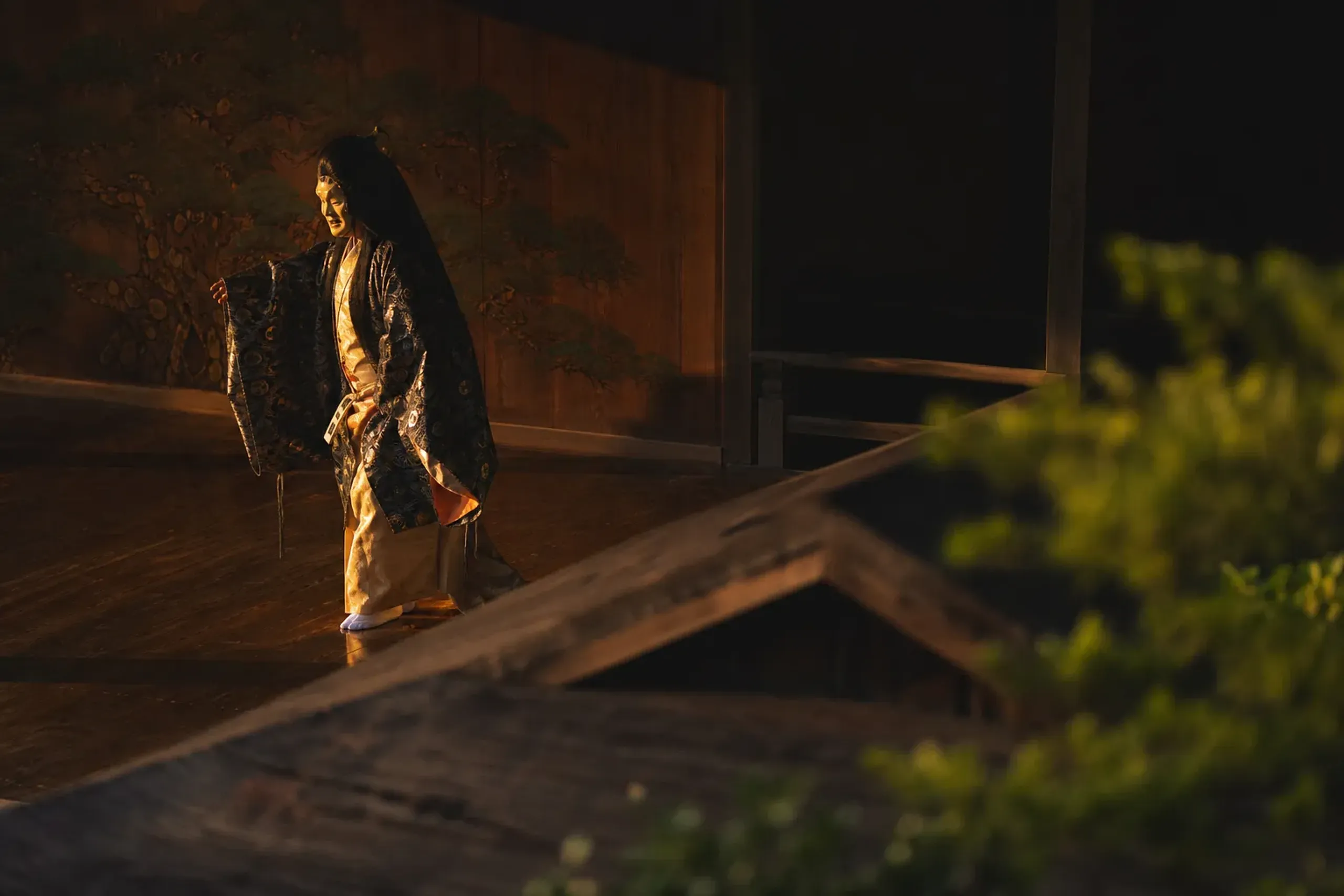
It is also, for a first audience, demanding. The pace is slow to the point of stillness, and that is by design. Which is exactly why it rewards a guest who has been prepared for it rather than one who discovers it cold. The single most valuable thing added to a first viewing is a short introduction from the performers themselves, before the programme begins — and we build that in as a matter of course.
One constraint should be stated at the outset, because everything else depends on it: lead time. Performers, chorus and instrumentalists are engaged individually, and the more complete the programme, the longer it takes to assemble. A costumed play needs months.
The formats — the real decision
What a client is genuinely choosing between is not a piece but a format. Everything else follows from it. Each of the five below is a different amount of Noh, and each suits a different party.
Shimai — the dance, stripped bare
A short danced excerpt, five to ten minutes long. One performer in montsuki and hakama — no mask, no costume — accompanied by the jiutai chorus alone. There are no instrumentalists. This is the most commonly arranged private format and the most distilled: nothing but movement and voice. When someone speaks of the discipline of Noh, this is where you see it undecorated — footfall on wood, the turn of a shoulder, the chant holding the room.
Maibayashi — the music arrives
Dance with the jiutai chorus and the hayashi instrumentalists.
Still no mask, still no costume. The whole difference is the arrival of the musicians, and it is the moment a first-time listener finally hears what Noh actually sounds like — the flute's cry, the sharp report of the drums, the shouted calls of the players between beats. If you want to understand the sound of the form before its spectacle, this is the format.
Han-nō — half Noh, fully dressed
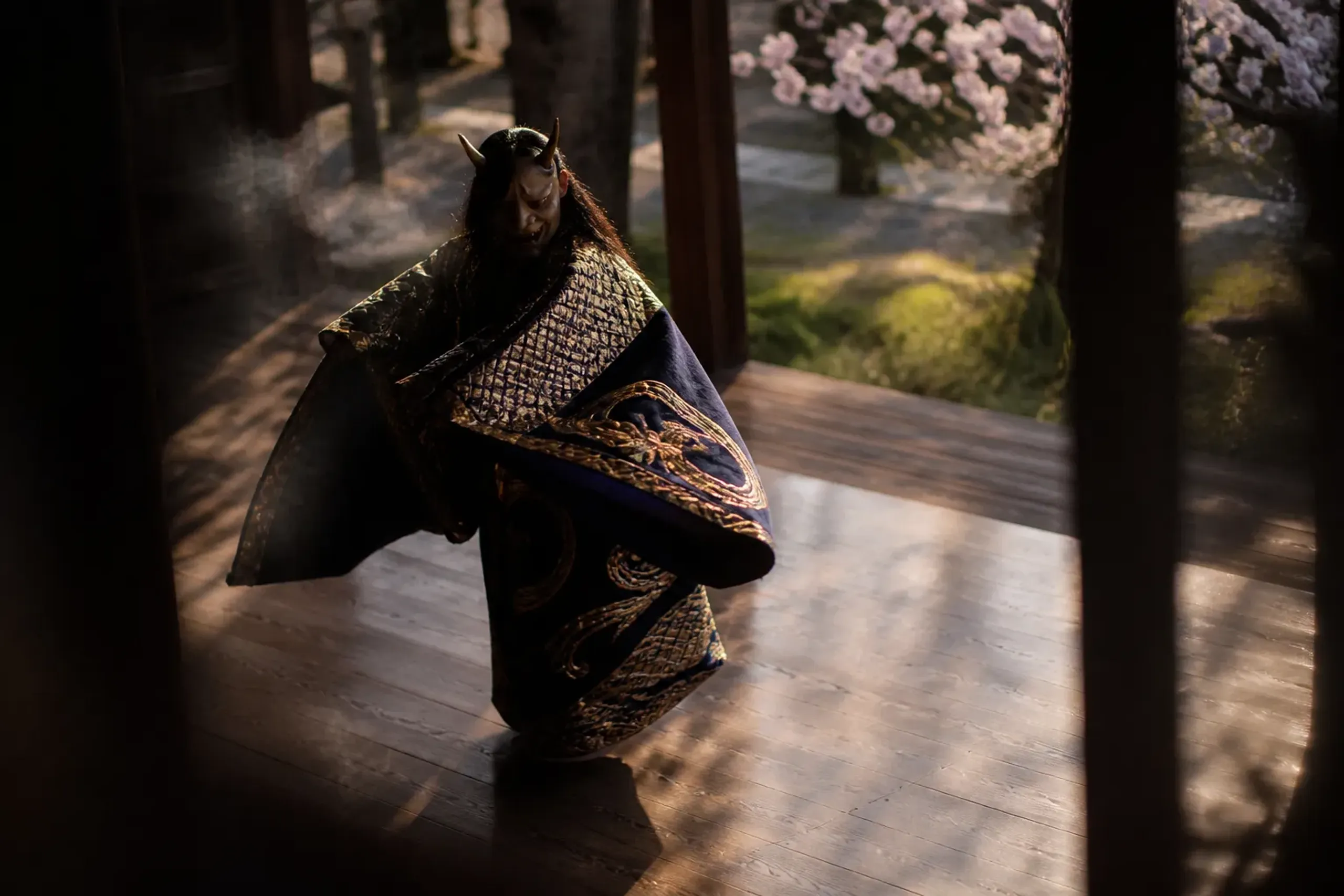
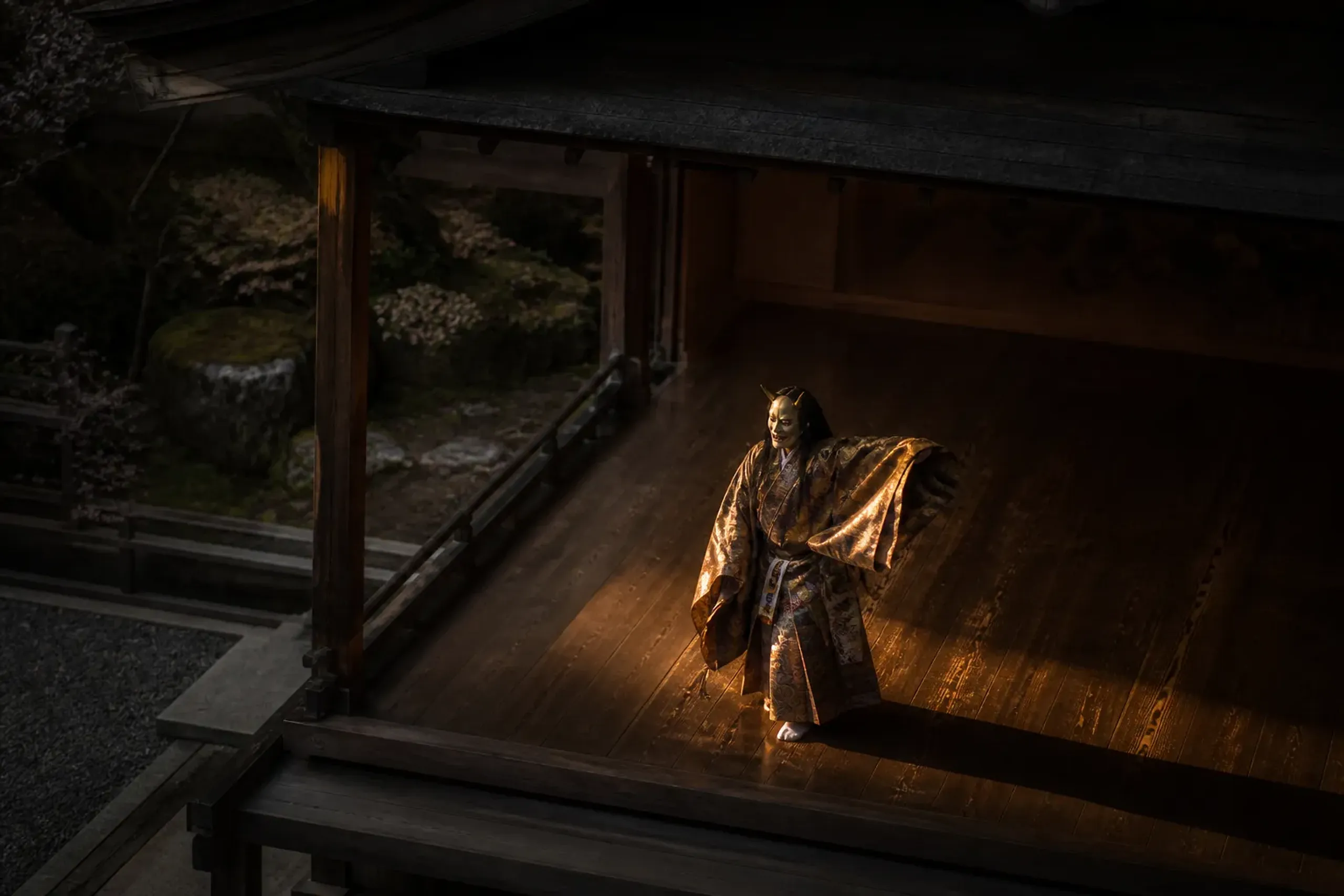
The second half of a play performed in full mask and costume, with the first half omitted or summarised. This is the practical middle ground: the visual and musical completeness of a full performance at roughly half the length and half the commitment. For most clients who want the costumed experience — the mask turning in the light, the layered robes moving as one — this is our recommendation.
A full play — the serious commission
Shite, waki, supporting roles, the jiutai chorus and the full hayashi — a company of fifteen or more — running roughly two hours. This is a different order of undertaking, with a long lead time to match. It is for the client who wants the whole architecture of a play, not its climax alone.
Kyōgen — the release
Spoken rather than chanted, and performed mostly without masks — kyōgen has only around thirty mask types in all. Traditionally staged between Noh pieces, it gives a programme its breath and its humour. We recommend it within a mixed programme rather than as an afterthought; it is what keeps a first viewing from becoming an endurance test.
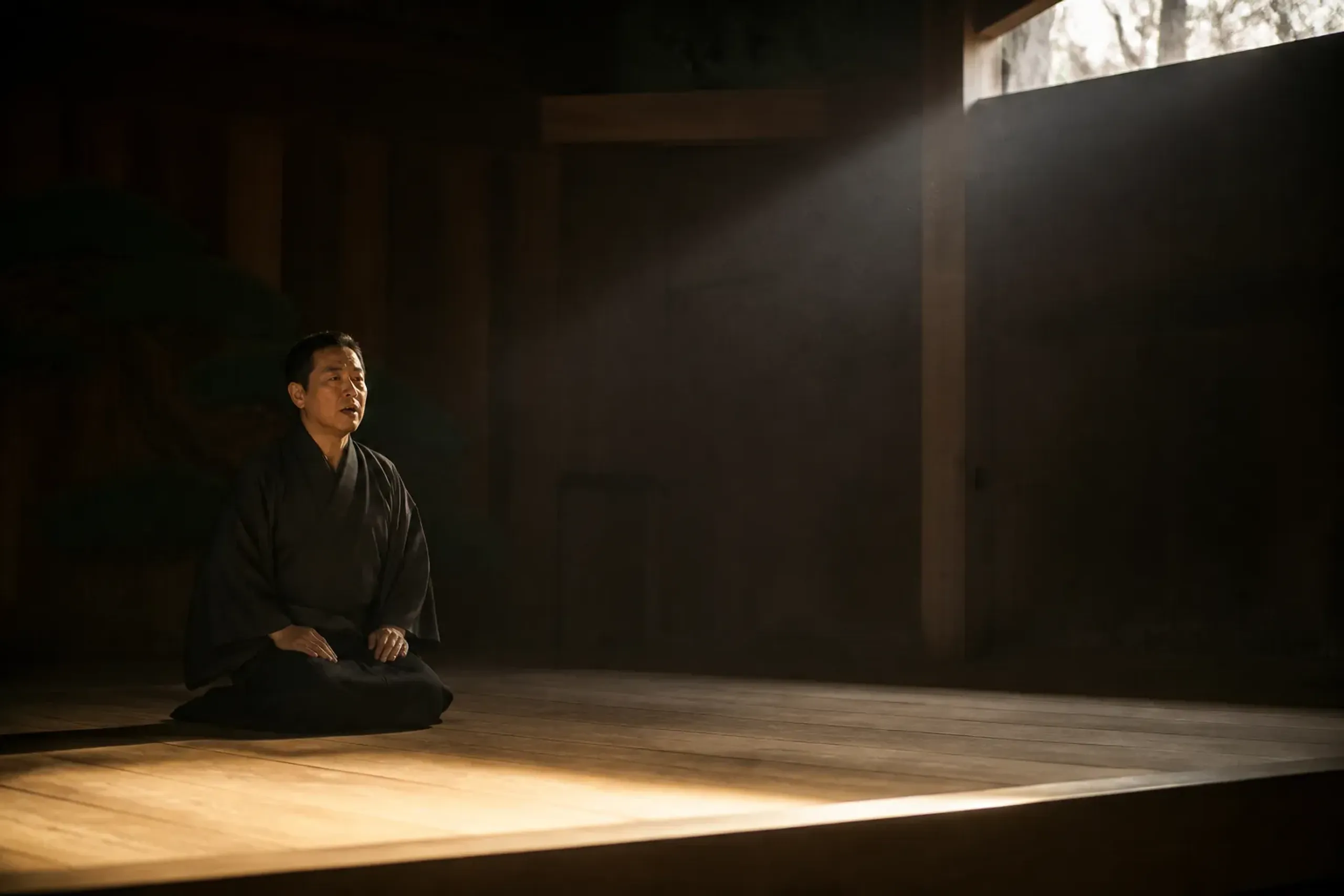
Which suits whom? A party of six with two hours to give is best served by a programme of shimai and kyōgen — movement, voice and release, without the long assembly of a costumed cast. A client who wants the costumed experience should look to han-nō. A full play is a different commitment entirely, and should be approached as one.
The hayashi
The instrumental ensemble is called the shibyōshi, and it is four instruments: the fue flute, the kotsuzumi shoulder drum, the ōtsuzumi hip drum, and the taiko stick drum. The taiko is not used in every piece — it is standard in the demon pieces and appears selectively elsewhere. Part of what makes the drums impossible to reproduce on a recording is that the sound is not only the skin struck but the player's voice, called out to mark the beat.
The mask
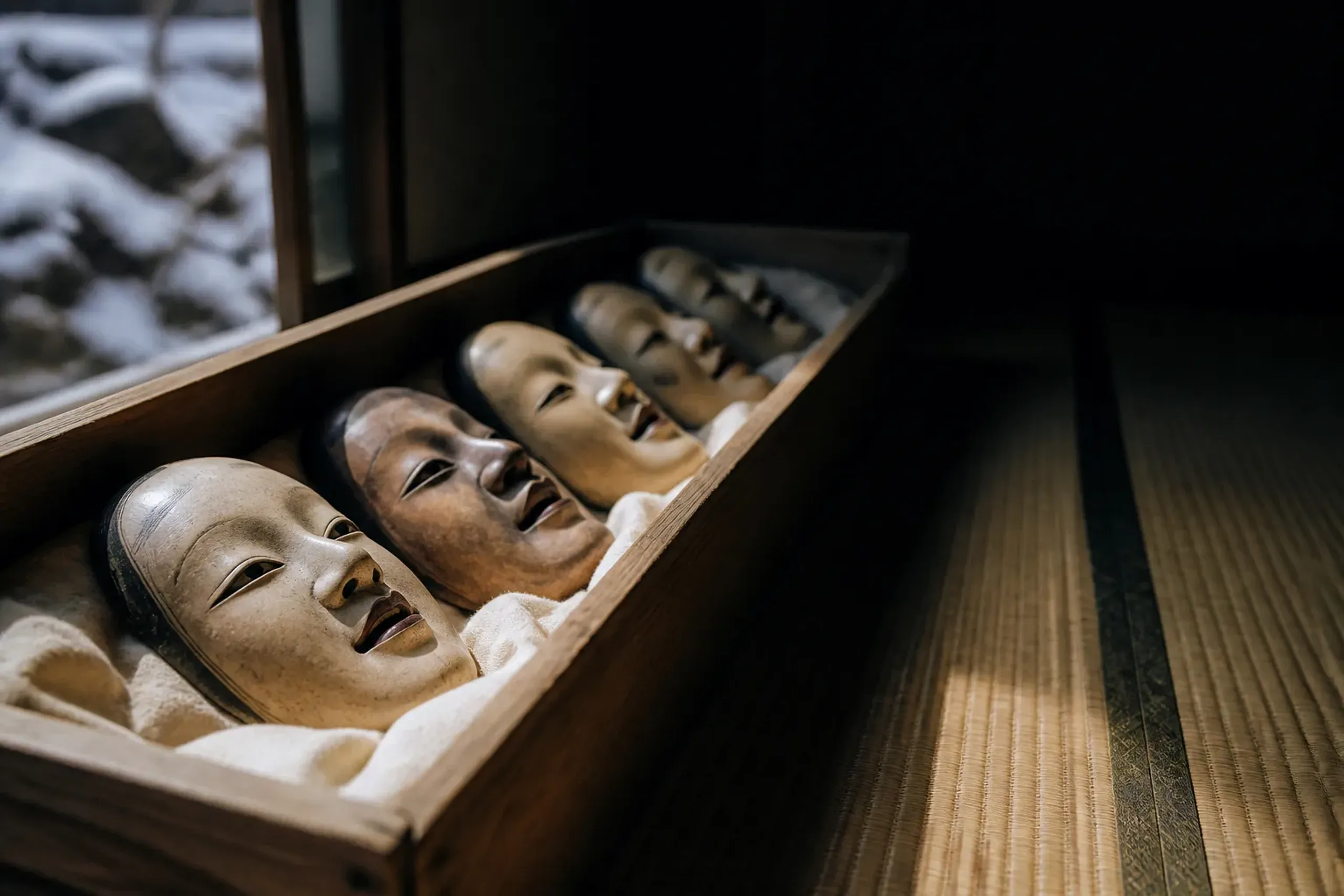
The mask is called omote — not men, and never o-men. It is carved from hinoki cypress, occasionally paulownia, camphor or katsura. Roughly two hundred and fifty types exist, built on about sixty basic forms.
Its most celebrated quality is that it appears to change expression while remaining perfectly still. Tilting the mask slightly upward — terasu — reads as joy or lightness. Tilting it slightly down — kumorasu — reads as sorrow or restraint. But real performance is far subtler than those two words suggest; a shokunin of this form works in gradations no vocabulary captures, and it does the art no favours to present it as a simple trick of angle.
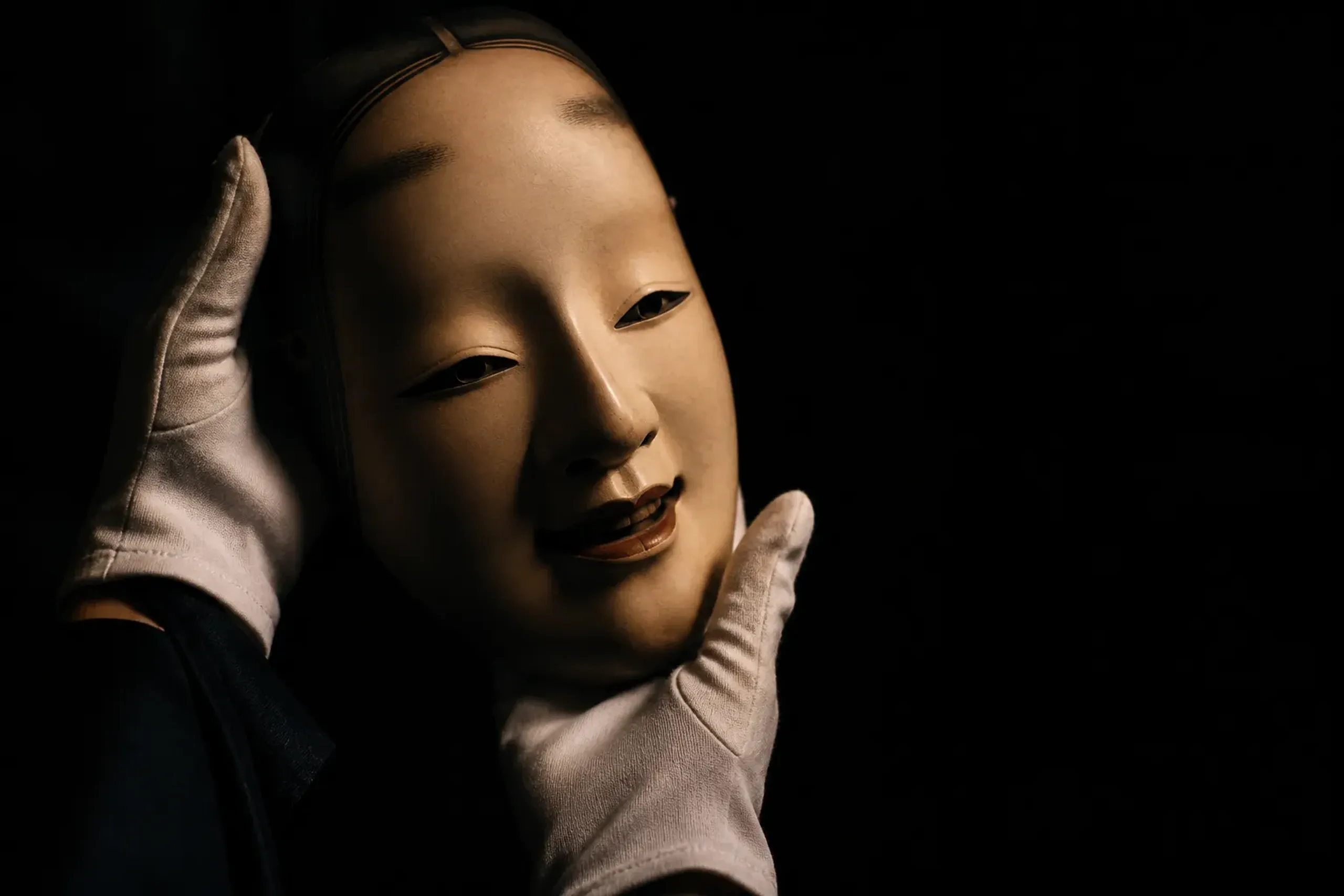
When a role is performed without a mask, it is called hitamen, and the performer holds the same inner attitude as if masked — the face is not permitted to do the mask's work.
The five shite schools favour different masks for the same role. For a young woman, Konparu and Kita prefer ko-omote, Kanze the waka-onna, Kongō the magojirō — small distinctions that a knowledgeable guest will notice, and part of what makes each school's Noh its own.
The five categories
Noh pieces are classified in five groups — waki-nō (god), shura-mono (warrior), kazura-mono (woman), zatsu-nō or kurui-mono (madness and miscellaneous), and kiri-nō (demon) — shorthanded as shin-nan-nyo-kyō-ki.
This is best understood as a way of telling a listener what character a piece has, not as a strict order of performance. The origins of the so-called gobandate — the five-in-a-day programme — are unclear, and Edo shogunate performance records do not in fact follow it. Five Noh staged in a single day is almost never done now. Read the categories as a guide to temperament — is this a god piece or a demon piece — and they become genuinely useful.
The schools, as context
There are five shite schools — Kanze, Konparu, Hōshō, Kongō and Kita — and two kyōgen schools, Ōkura and Izumi.
We name them here only as context. Which school performs for a given arrangement is not something we state without the performers' consent.
What a first viewing asks of you
Three things are worth carrying into the hall. First, that Noh is slow by design, and that this is not a fault to be borne but the medium itself. Second, that the chant is not sung in the Western sense and is not meant to be followed word by word — you let it move over you rather than parse it. Third, and most important, that a brief introduction from the performers before the programme transforms the whole experience. Arranging that introduction is the single most valuable thing a concierge adds here, and it is a standing part of what we do.
The room it happens in
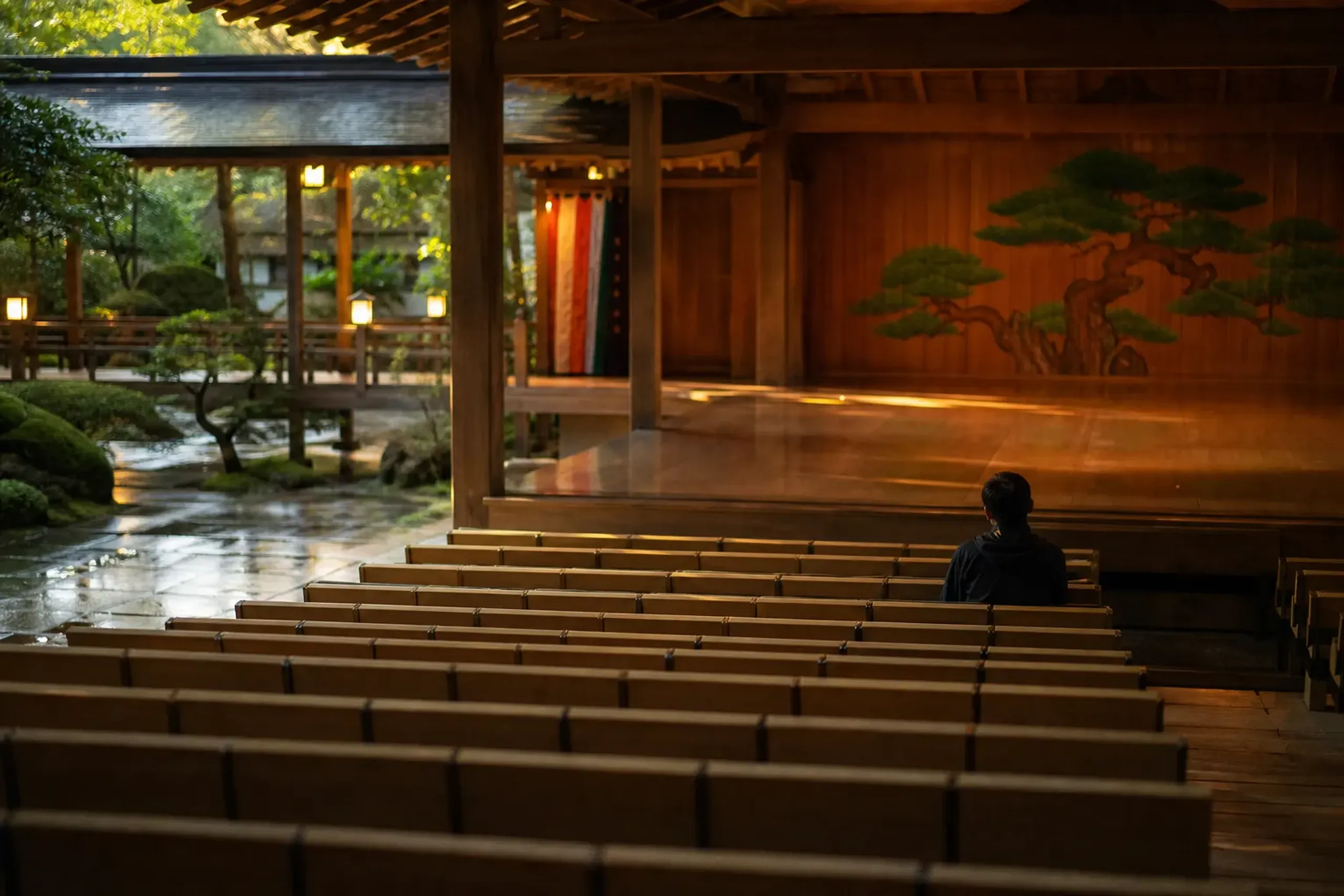
Here we must be exact, because a guest who knows Noh will look for the bridge. The setting is not a Noh stage in the architectural sense. It is the Geinō Hall of the Kagawa Prefectural Culture Hall — a 233-seat theatre-format hall, its stage roughly ten metres wide, six deep and four high, used for nohgaku, music, dance, theatre and rakugo alike. It has no hashigakari bridge, no four pillars, no stage roof. Noh is performed there; it was not built as a Noh stage.
Being straight about this is more persuasive than implying otherwise, and it makes the honest point plainly: a private commission buys you proximity and a programme of your choosing — not a temple stage.
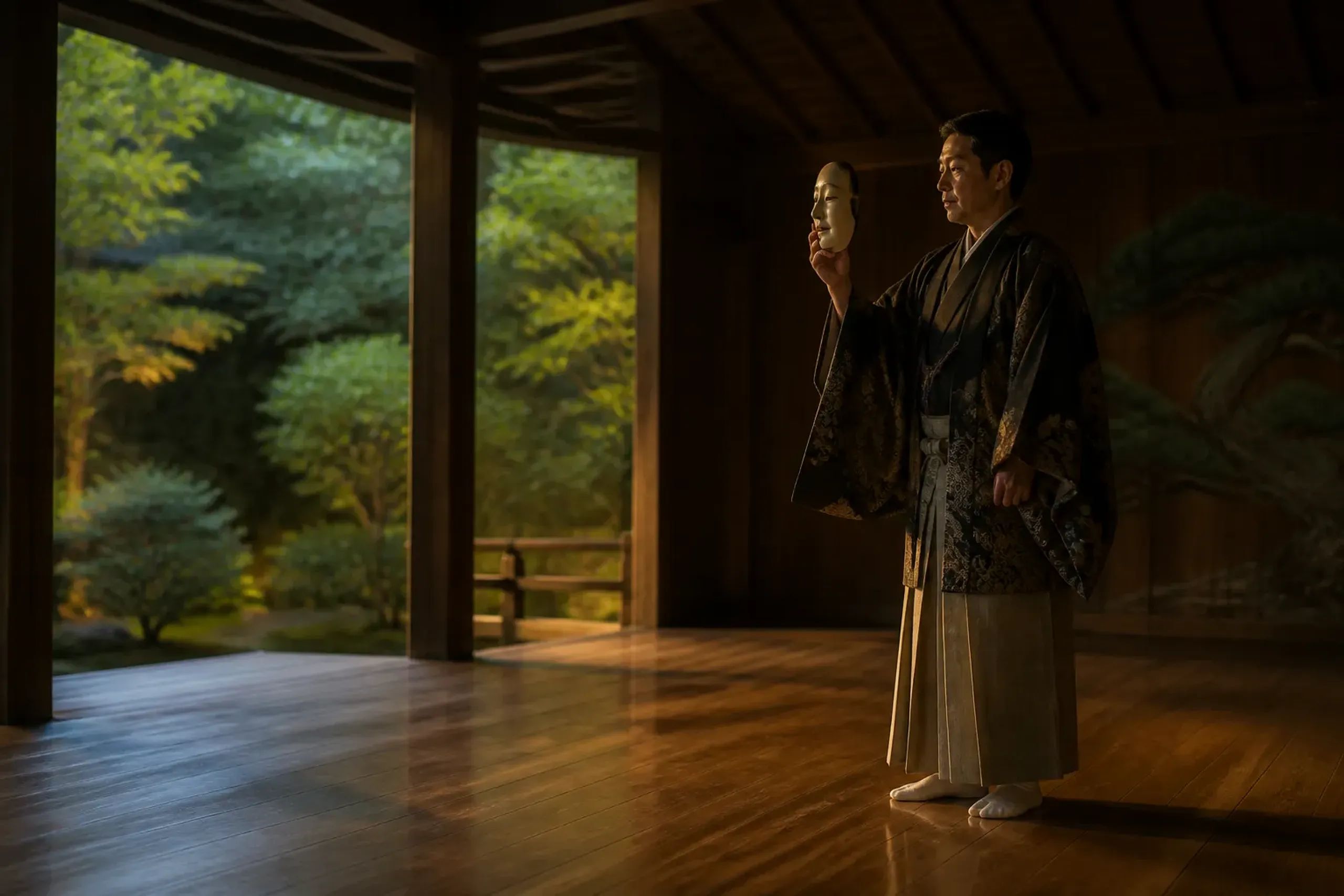
In a 233-seat room, a small private party occupies a handful of seats in a large hall, and you should picture it that way.
The tatami rooms — the genuine alternative
The building's fourth floor holds tatami rooms — of 27, 10 and 4.5 mats, the smallest a tea room — and for a small, intimate programme these are not a fallback but the better answer. A shimai and a kyōgen performed for a party of eight, close enough to hear the fabric move and the breath before the flute, belong in a room of this scale far more than in a theatre built for two hundred. For a party of eight, the tea room may genuinely be the right choice. It is the kind of restraint — a small room, a single unaccompanied dancer, silence between the notes — that this form was made for.
Lead time and party size
Two practical matters govern everything. Venue booking at the Culture Hall runs on an application, in fixed blocks — morning, afternoon or evening. This is not a same-week arrangement. And the real constraint, as noted, is lead time: performers, chorus and hayashi are engaged individually, and a full play needs months to bring together. The earlier the conversation begins, the more complete the programme that becomes possible.
Party size deserves the same honesty. The hall seats 233, so a small group sits in a large room unless the programme moves upstairs to the tatami rooms — which, for anything under a dozen guests, we would usually suggest it should.
Why this hall exists at all
There is a reason a Noh performance happens in this particular building. The Kagawa Prefectural Culture Hall was commissioned by Governor Kaneko Masanori specifically to give Kagawa a stage for Noh and the traditional performing arts, designed by the architect Ōe Hiroshi and completed in 1965 — a modernist frame built to hold an old art. If the architecture interests you in its own right, the story of Kagawa's modernism is a day of its own at this port.
What we arrange
Japan Royal Service arranges private Noh and kyōgen programmes across all formats — from a single unaccompanied shimai to a full costumed play — at the Kagawa Prefectural Culture Hall or another suitable venue, together with the interpreter and the pre-programme introduction without which a first viewing is a beautiful thing half understood. We do not name performers or schools as part of an arrangement without their consent, and we treat the identity of our guests and the shape of their itineraries with the same discretion. For arrival and departure, we can fold the day into a private, chauffeured transfer and a wider tailor-made itinerary across the region.
More on this rotation
- Sanukite, the stone that rings — Takamatsu
- The stonecutters of Aji — Takamatsu
- Isamu Noguchi's studio at Mure — Takamatsu
An invitation
A privately commissioned Noh performance is one of those experiences that Japan does not put on a menu — the kind of quiet, curated access that begins with a single conversation about what you would most like to see.
To begin that conversation, please contact us here. We do not publish our clients, our itineraries, or our rates.