
In this guide
Mure and Aji, Takamatsu — a private shore day into Japan's finest stone country, arranged by Japan Royal Service.
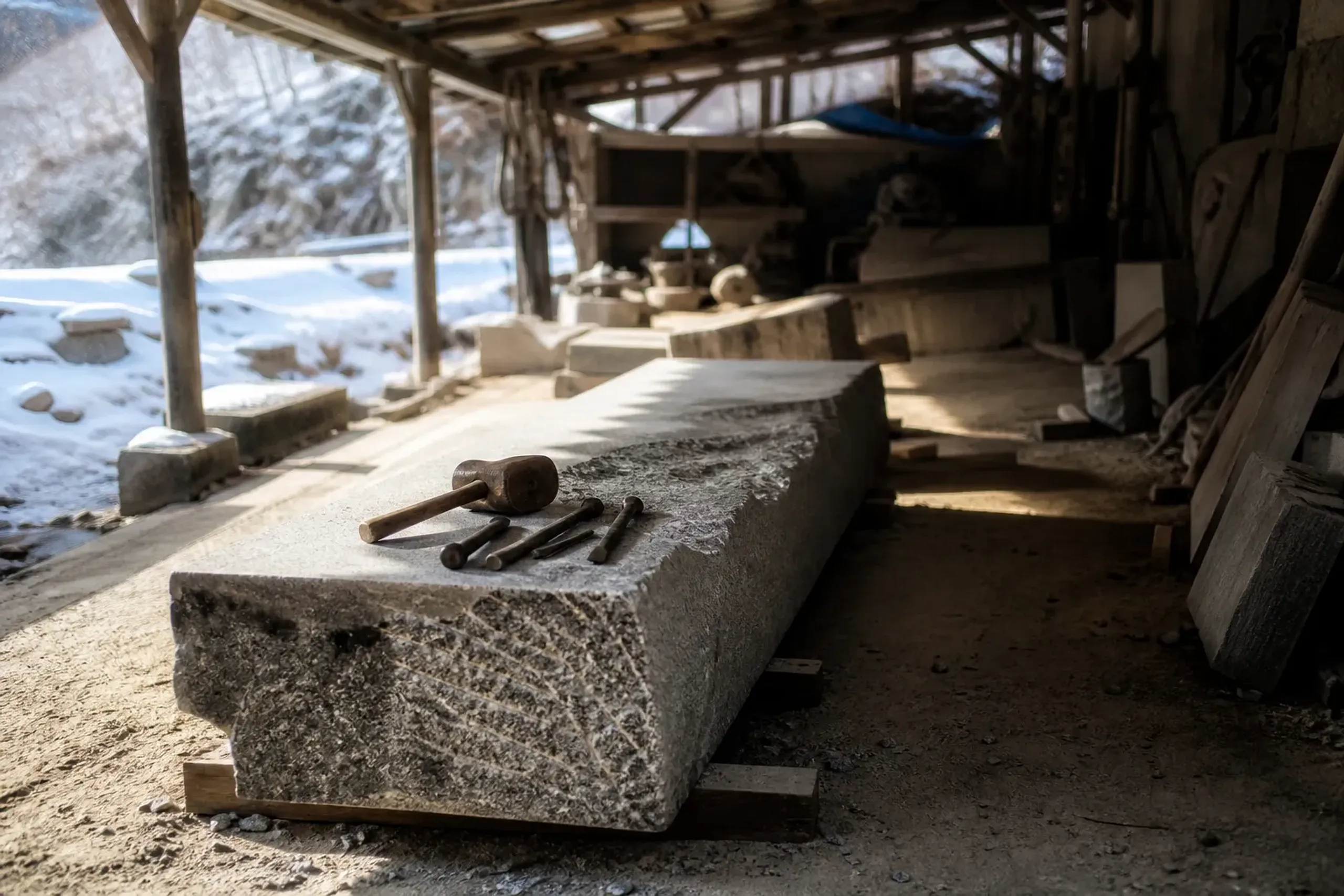
Begin with the sound. In a low workshop a short drive inland from the Takamatsu berth, a craftsman sets a chisel against a block, taps it once to seat the edge, then strikes in a steady rhythm you feel in the floor before you hear it. Grey dust hangs in the light from the doorway. The block does not shatter — it yields, a clean scale peeling away exactly where he asked it to. This is the granite the trade calls the diamond of granite, and it is the reason a place most travellers have never heard of has drawn sculptors, masons and, in time, a foundation from halfway around the world.
Most visitors to Japan carry home something a craftsman made. Very few stand in the country the material came out of, on the morning it is being worked, close enough to understand why so little of what leaves this ground is ever called Aji stone at all.
The hardest granite in Japan
Aji stone is quarried in only two places on earth: Aji-chō and Mure-chō, on the eastern edge of Takamatsu. Nowhere else. Geologically it is a fine-grained biotite granodiorite, formed in the late Cretaceous some eighty million years ago and lifted to the surface by later movements of the crust. The trade calls it the diamond of granite — reputedly the hardest and most expensive stone in Japan — not as a slogan but because it behaves like one under a tool.
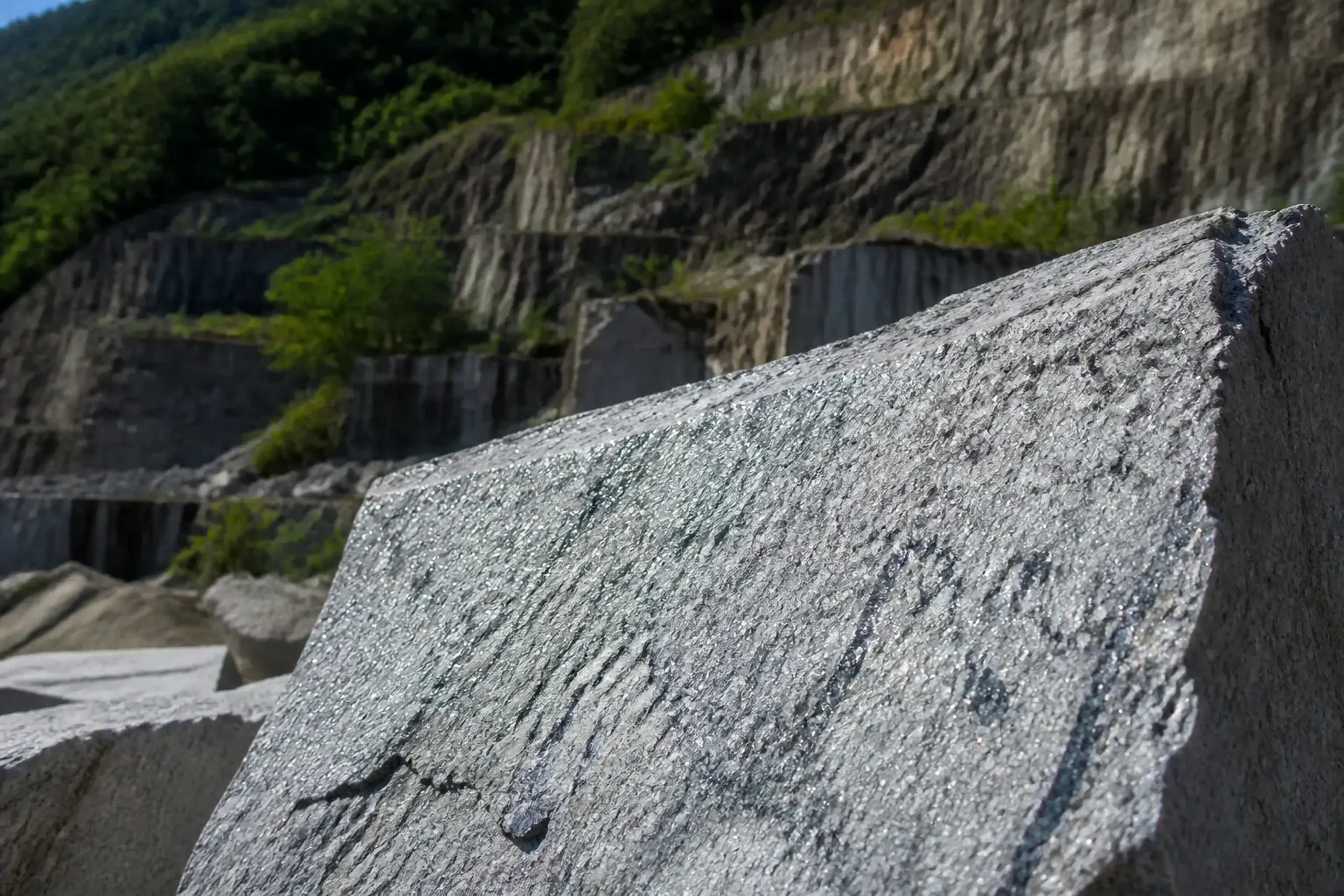
It resists. It holds an edge that softer stone surrenders. It takes a polish that seems to go down into the block rather than sit on its face.
The material is the reason the place matters, not the other way round. Understand the stone and everything else on this coast — the museum, the divided trades, the sculptor who never left — follows from it.
Fu, nebari, and the three to five percent
When Aji stone is polished, something appears that the raw block gives no hint of: a faint, doubled mottling in the crystal, like a kasuri pattern woven into cloth, as though the surface had just been moistened. The masons call it fu ga uku — "the figure floats." It comes from the small biotite crystals distributed through the stone, and no two blocks carry the same figure. It cannot be manufactured, cannot be read from the outside of a block, and it is graded by the fineness of the grain — komame, chū-komame and chūme, with komame the finest of all.
Then there is nebari — a toughness, almost a stickiness, that makes the stone fracture finely rather than chip. It is why a carver can cut the eyes and brows of a small Jizō and trust the granite not to crumble under the last delicate strokes. Hardness and tenderness in the same block.
And here is the single fact that explains the rest: only about three to five percent of the stone taken from these hills qualifies as genuine Aji stone.
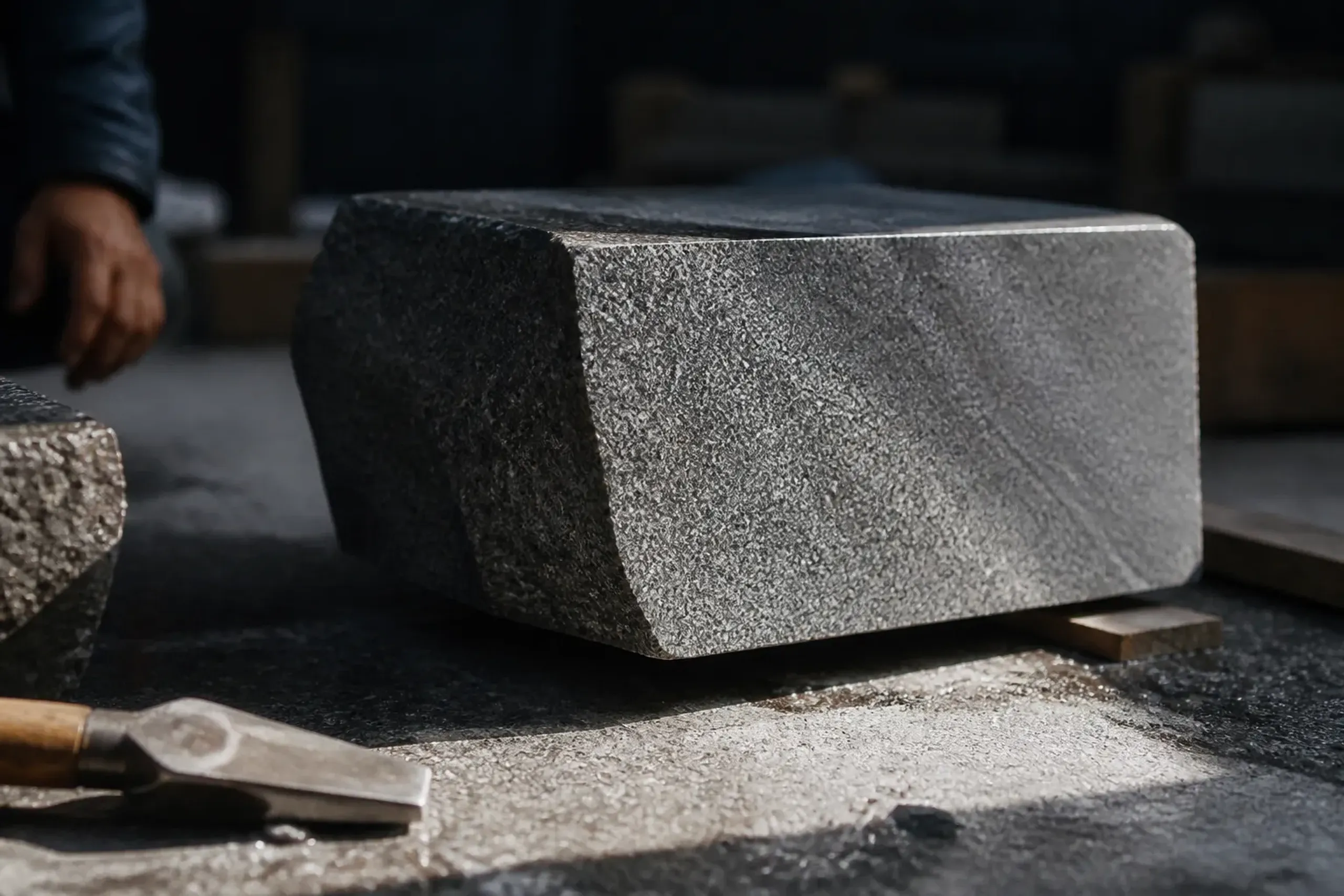
The rest is granite — perfectly good granite — but not this. Ninety-five parts of the mountain are moved to keep five. A reader who holds that figure in mind understands why the finished pieces cost what they cost, why the trade guards its name, and why standing at the source is not the same as reading about it.
The mountain, seen but not entered
The quarries lie on Gokenzan, the mountain whose five sword-like peaks give it its name; the fifth collapsed in the Hōei earthquake of 1707. In the Edo period the Ōchōba here was the Takamatsu domain's official quarry. Quarrying still proceeds only under prefectural permit and to an approved plan, and the craftsmen read the rock the way a woodsman reads grain — following the kasane-hada that run north to south and the niban-hada that run east to west, taking their stone from the sound ground between them.
Let us be plain about one thing, because it matters more than a polished promise would. The working quarries are not visitor destinations. They are active industrial sites under prefectural permit — broken ground, sheer drops, machinery in motion — and no arrangement, at any level, puts guests on the quarry floor. We say so before the day rather than after.
The substitute is genuinely good. The quarry faces on Gokenzan can be seen from the observation deck in the museum park, and again from Dankōrei on Yashima, across the water, where the exposed rock of the cut mountain reads clearly from the far shore.
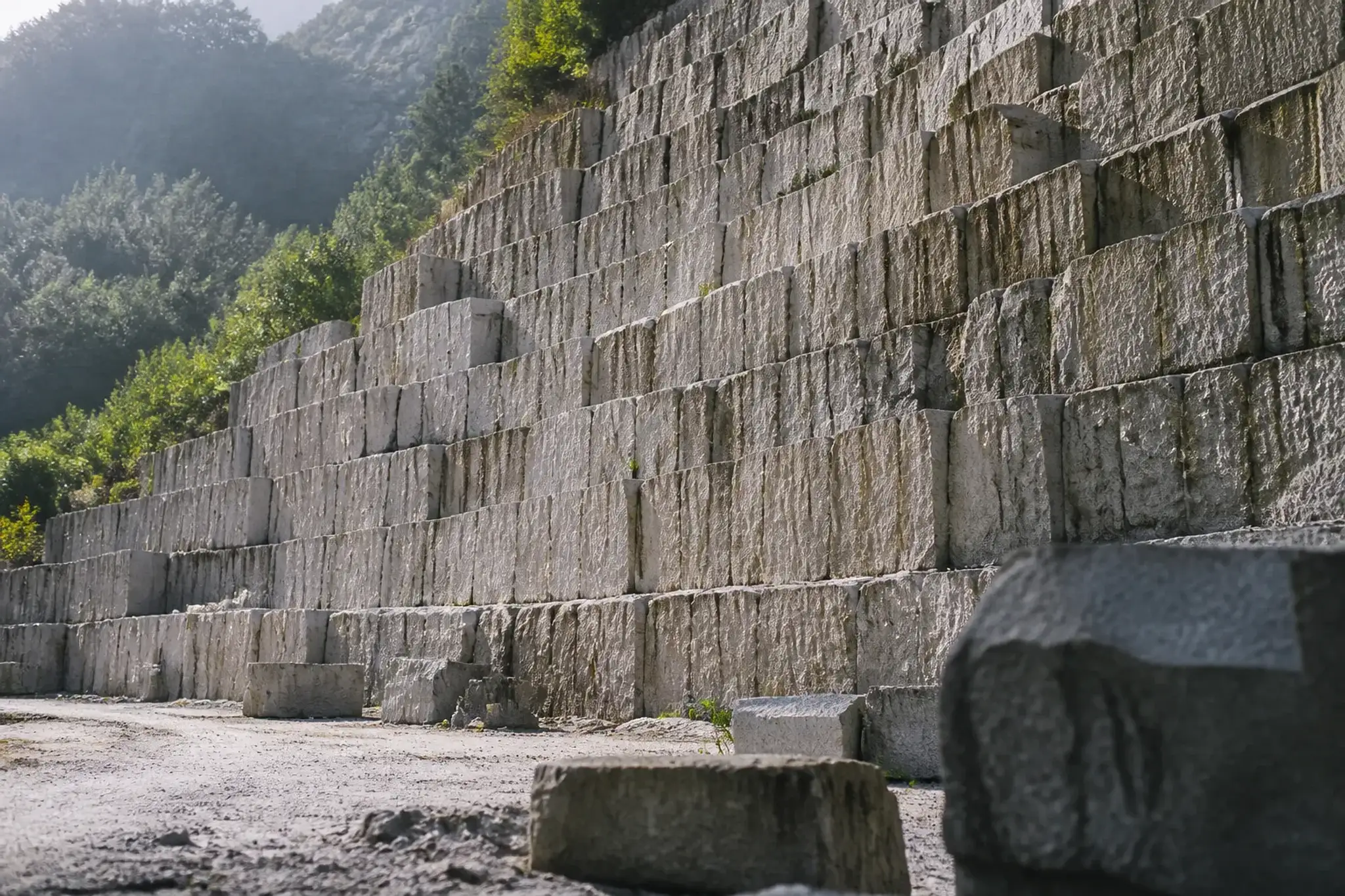
You see the scale of what is being taken out of the hill without needing to leave firm ground, and the view — the mountain opened like a book — tells its own story.
The museum, and its designated tools
Everything the hand does to this stone is gathered in one building. The Takamatsu City Stone Folk Museum stands at 1810 Mure, in Sekishō-no-Sato Park; it opened in March 1995 and was formally registered as a museum in 2013. Its holding of Mure and Aji stonemasons' tools — 791 items in all — was designated an Important Tangible Folk Cultural Property of Japan in December 1996.
Pause on that. A country that enters its stonemasons' chisels into the national heritage register is making a statement about what the trade means, and it is the clearest evidence you will find of how this district regards its own work. Inside, life-size dioramas recreate the pre-war world of the cutters — stone hauled downhill on a shura sledge, the shaping floor, the polishing bench. Hundreds of original tools are on display, and many of them visitors are invited to take up in their own hands and feel the weight of.
The practicalities, plainly stated. General admission is ¥300. Group visits require an application form submitted in advance by email or fax — a real logistical constraint that shapes how a shore day is built, and one reason these arrangements are made ahead by someone working in Japanese rather than settled at the gangway.
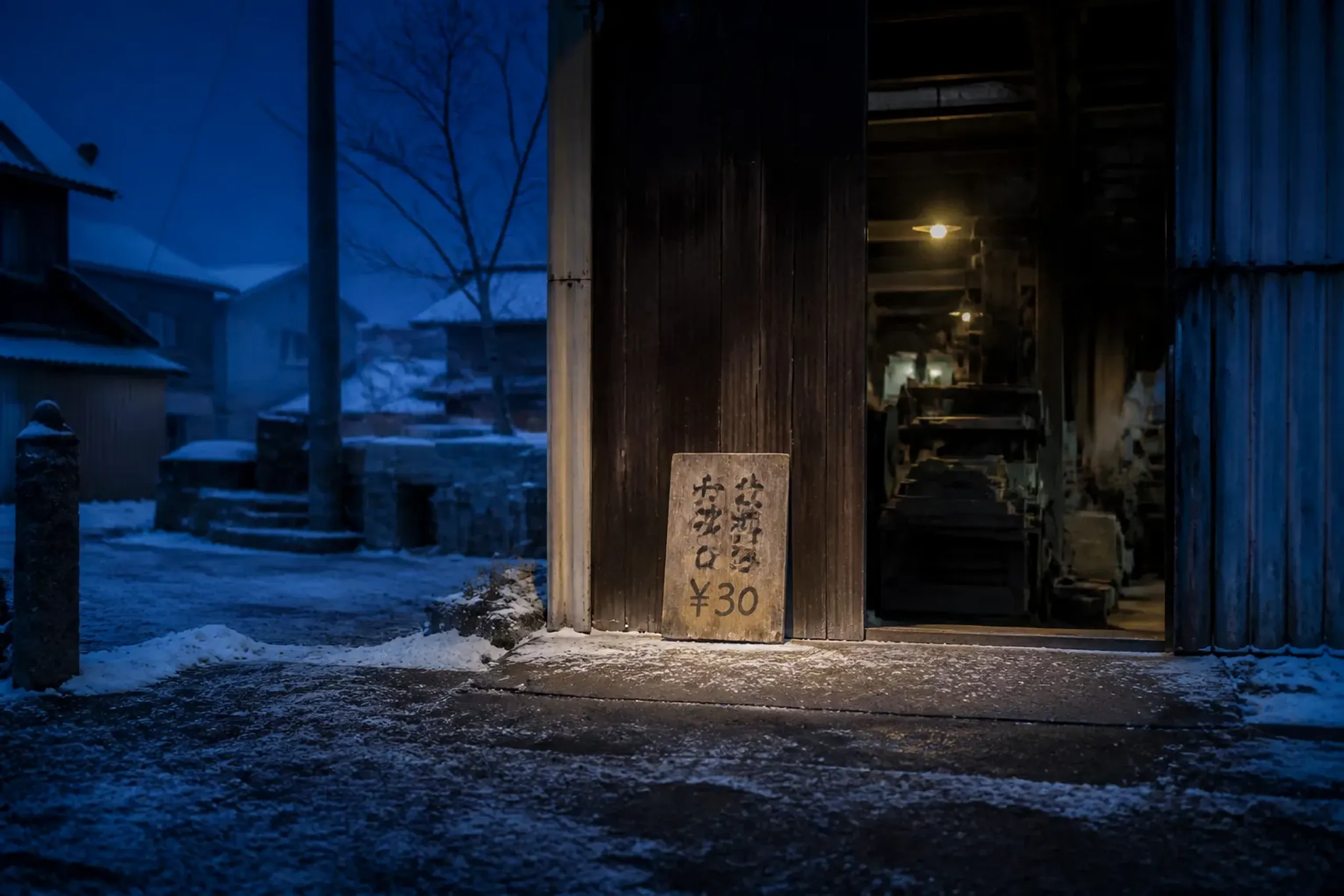
The surrounding park sets stone sculpture along its paths and carries the observation deck that looks out to the Gokenzan quarries and to Yashima. Please confirm current hours, admission and the group procedure at the time of your visit, as these change.
A village of specialists
What makes this district singular is not the stone alone. It is that the work has been divided, over generations, into separate trades on separate floors. Quarriers and processors split into distinct professions in the Meiji period, and the district still works that way today.
There is a quarry. There is a shaping works. There is a lettering works, where characters are cut. There is a hand-polishing works. A block moves between them, and the man on each floor does one thing for the whole of his working life. This is not craft as performance — it is a working industrial ecology that happens to be centuries deep and still running every day. Some forty quarrying firms and around 220 processing workshops operate in the district, which ranks with Makabe in Ibaraki and Okazaki in Aichi as one of Japan's three great stone-working centres. The trade arrived when stonemasons from Izumi Province — now southern Osaka — settled here in the nineteenth century during the building of Yashima Tōshōgū, and grew from there.
The stone has carried weight far beyond memorials and lanterns: Aji stone was chosen for the cenotaph at the Hiroshima Peace Memorial Park and for the base of the 1964 Tokyo Olympic cauldron.
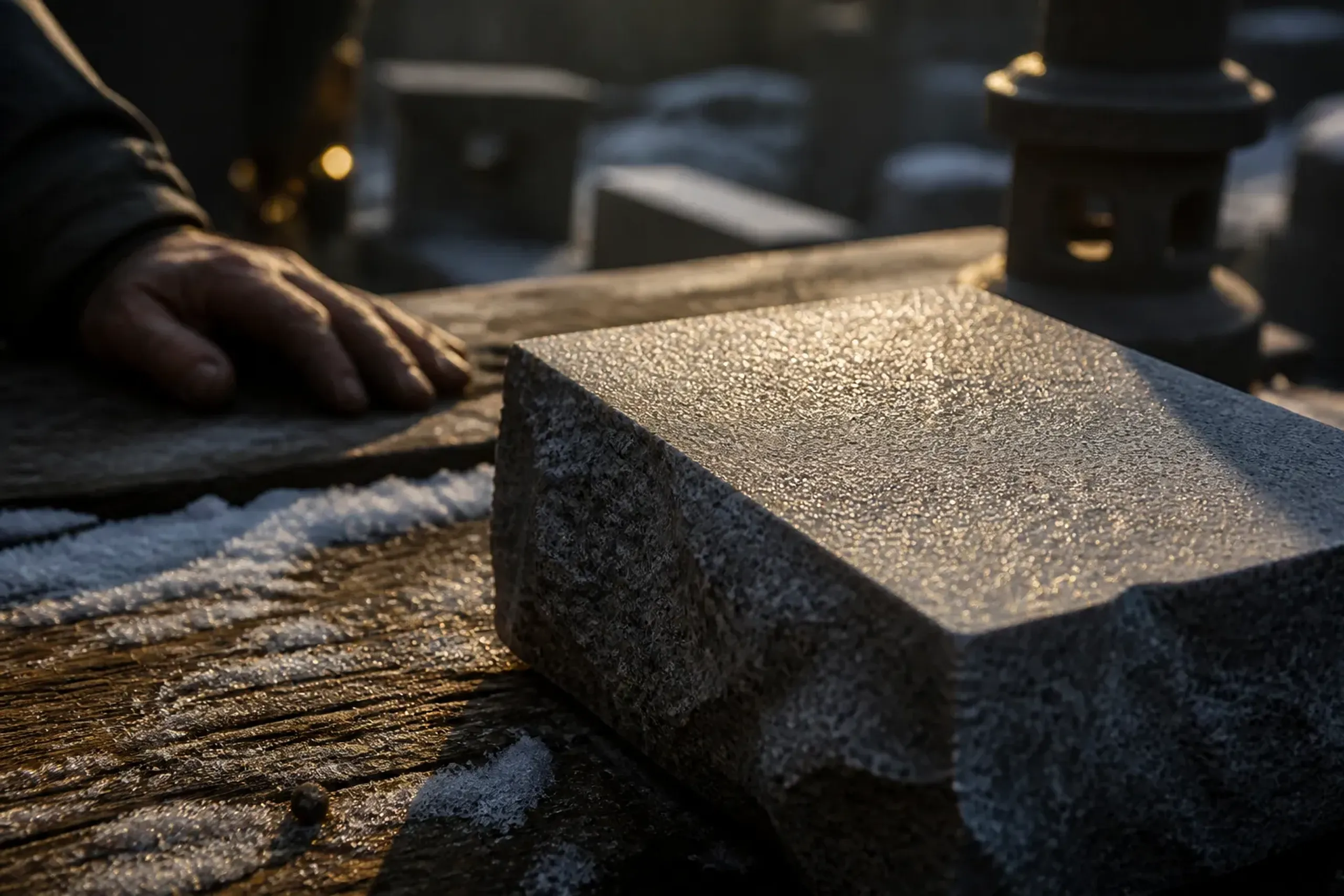
The district keeps its own phrase for the standard all of this holds to — 手間を惜しまず、名を惜しむ, spare no effort, guard the name.
Noguchi, and the artists who followed
Isamu Noguchi came to Mure in 1956, and the reason was the stone. He stayed the better part of twenty years, working the granite that could hold the forms he was after. Other artists followed him through the 1960s, and that quiet migration is a large part of why Kagawa came to be spoken of as an art prefecture at all. The material drew the people; the people made the place. Our companion journal on Isamu Noguchi's studio at Mure tells that half of the story; this one is the ground beneath it.
That lineage continues in the workshop of Izumi Masatoshi, the stone sculptor who worked alongside Noguchi for two decades and now chairs the foundation that keeps his legacy. His workshop is among the places a private visit can include — the space itself, the tradition it carries, the way the stone is read and worked there.
What a private visit involves
This is the part that repays the journey: watching stone worked by hand. Seeing a finished lantern or a polished plane is one thing; standing over the shaping floor as a craftsman peels a scale from a block along a line only he can see is another entirely.
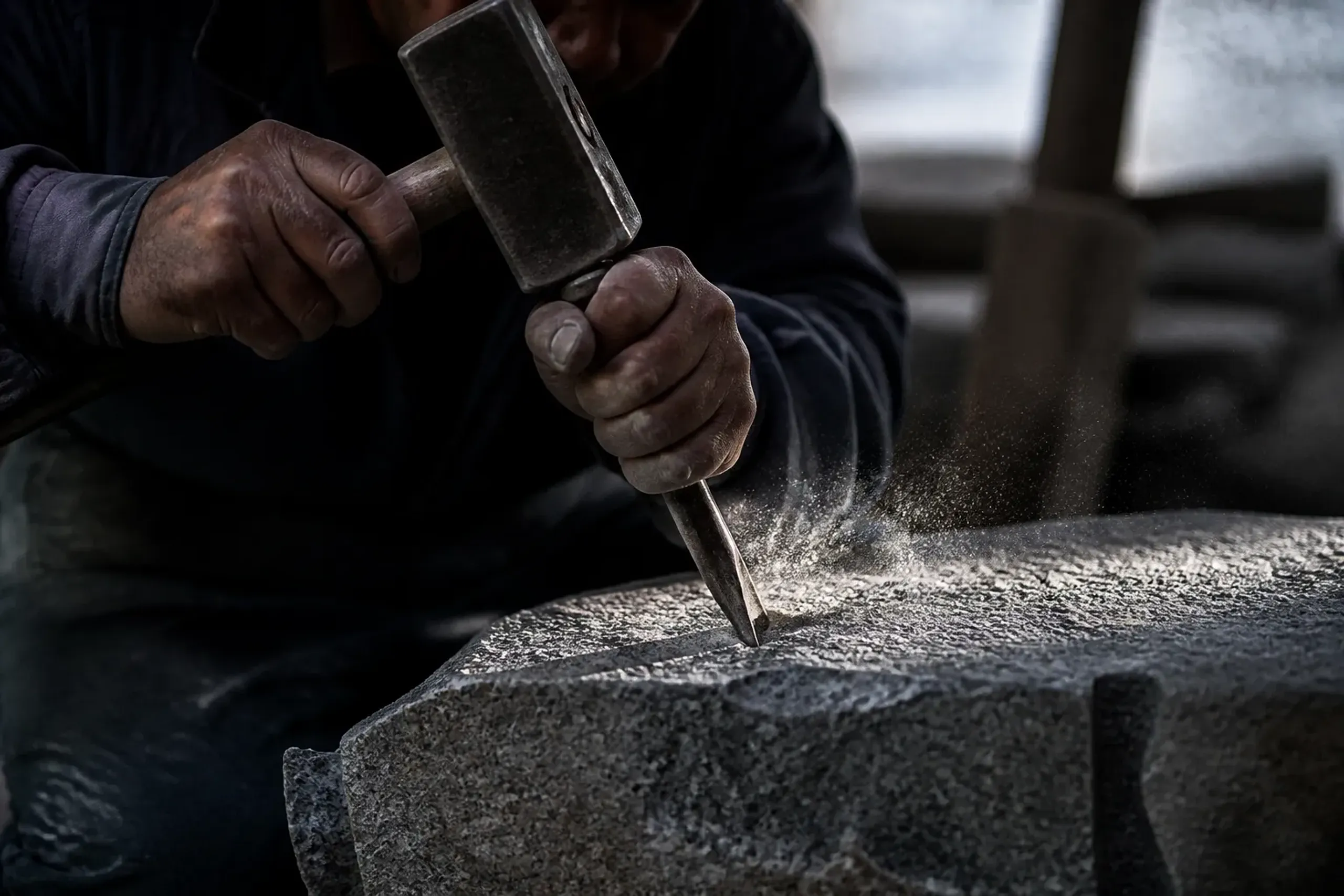
It is the difference the arrangement buys.
A private day here is built around the shokunin — the master craftsmen whose knowledge is the real inheritance of this coast. Through introductions made in Japanese, and with an interpreter present because the conversation with a working craftsman is the whole point and does not happen in English, a visit can hold the stone-craft museum with its designated tools, a workshop where the trades are seen at work, and access to Izumi Masatoshi's workshop and its lineage. A day can also take in the drive along the quarry hills and through the stone town, guiding the eye from the car to the cut faces of Gokenzan that cannot be reached on foot.
These are working people, not a spectacle, and the day is shaped around their rhythm rather than against it. Photography inside a workshop is only ever with permission. That restraint is precisely why the access means something.
Buying and shipping
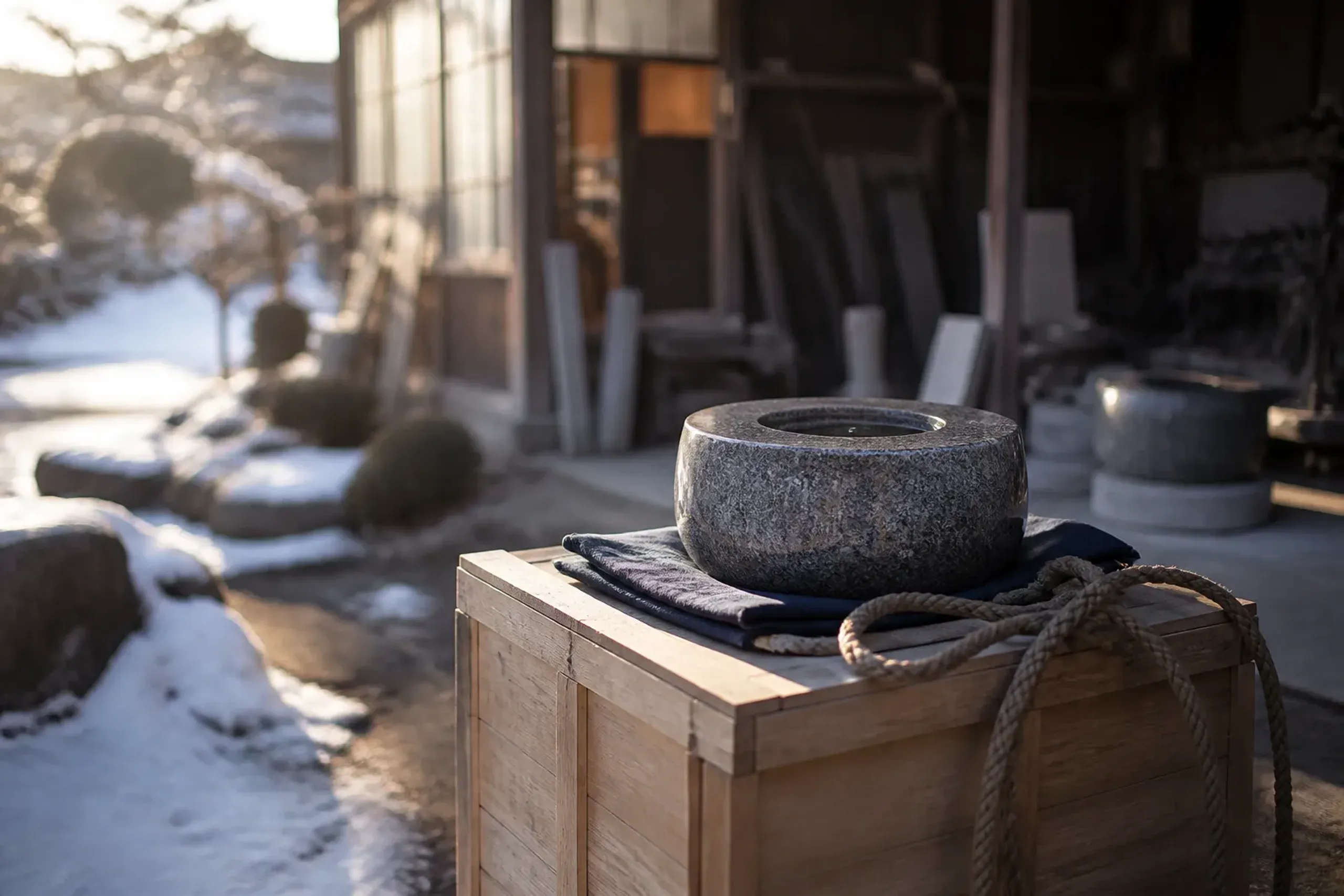
Aji stone can, of course, be commissioned and taken home — a lettered piece, a small carving, an object made rather than bought. It is worth saying honestly that the stone is heavy and that export is a real undertaking, one to plan for rather than improvise at the end of a visit. We coordinate commissions and their onward shipping through our wider network of Takamatsu artisans, so that a piece chosen at the source arrives properly, wherever home happens to be.
How the day fits the port
The geography does the work here. The museum, the workshops and the Noguchi museum all sit within the same short stretch of the Mure and Aji coast, a quarter-hour from the Takamatsu berth. The raw hill, the trade that works it, and the sculptor who came because of both can be walked in one coherent half-day, with a private car and driver holding the thread between them. For a fuller day ashore, it pairs naturally with the strolling garden at Ritsurin and the workshops nearby. It is, so far as we know, the only place in Japan where that particular sequence — quarry, trade and art — can be gathered into a single morning.
Frequently Asked Questions
Can we go into the quarry itself?
No — not on foot, and not by any arrangement. The quarries are active industrial sites under prefectural permit, with broken ground, drops and machinery. Instead, the quarry hills and stone town are seen from the car, and the cut faces of Gokenzan are viewed from the museum park's observation deck and from Dankōrei on Yashima across the water.
Can we actually work the stone?
Yes. A workshop visit can include tools in your own hands, alongside a demonstration by the craftsmen, when arranged in advance.
How long does a visit take?
The workshop portion can be built to the length that suits you, and the museum and the drive along the quarry hills can be added on either side to fill a coherent half-day from the berth.
Is English spoken at the workshop?
No. The conversation with a working craftsman is the point of the visit, and it happens through an interpreter, whom we supply.
An invitation
To stand in the dust of a working floor as a block splits cleanly along its grain is to understand this coast in a way no showroom can teach. We arrange these mornings quietly, in Japanese, with the people who own these places, and we hold our guests' identities and itineraries in complete confidence. To begin shaping a day in the stone country of Aji and Mure, contact us here — or ask us to fold it into a wider tailor-made itinerary through Japan.