Seasons
Shirakawa-go in Quiet Luxury: A Private Guide to Japan's Hidden Gassho Village
A private guide to Shirakawa-go's UNESCO gassho-zukuri village in Gifu — seasons, farmhouses, and how Japan Royal Service reveals it beyond the crowds.
There is a particular silence in the Shogawa valley. It settles over the thatched rooftops just after the last tour bus pulls away, when the light turns amber and the rice fields exhale mist. Most visitors never feel it. They arrive at midday, they photograph, they leave.
That is the wrong way to meet Shirakawa-go.
This mountain hamlet in Gifu Prefecture, a UNESCO World Heritage site since 1995, rewards the traveler who slows down. The traveler who stays past dusk, who is introduced into a farmhouse rather than queuing outside it, who understands what they are looking at. At Japan Royal Service, we have spent years learning the rhythm of this valley — the hours when it belongs to almost no one. This guide shares what we know.
Why Shirakawa-go Still Matters
Shirakawa-go sits roughly an hour and a half by road from Kanazawa, and a little over an hour from Takayama. It is remote on purpose. For centuries the mountains around the Shogawa River cut this community off from the rest of Japan, and that isolation shaped everything — the architecture, the farming, the way neighbours depended on one another.
The village earned its World Heritage listing alongside the smaller settlements of Gokayama, in neighbouring Toyama Prefecture. UNESCO recognised not only the buildings but the living cultural landscape: a way of life that adapted, survived, and never fully disappeared.
What you see today is not a museum reconstruction. People still live here. Roofs are still re-thatched by hand. That authenticity is precisely what makes the place worth protecting — and worth experiencing with care rather than haste.
The Gassho-Zukuri Farmhouses, Explained
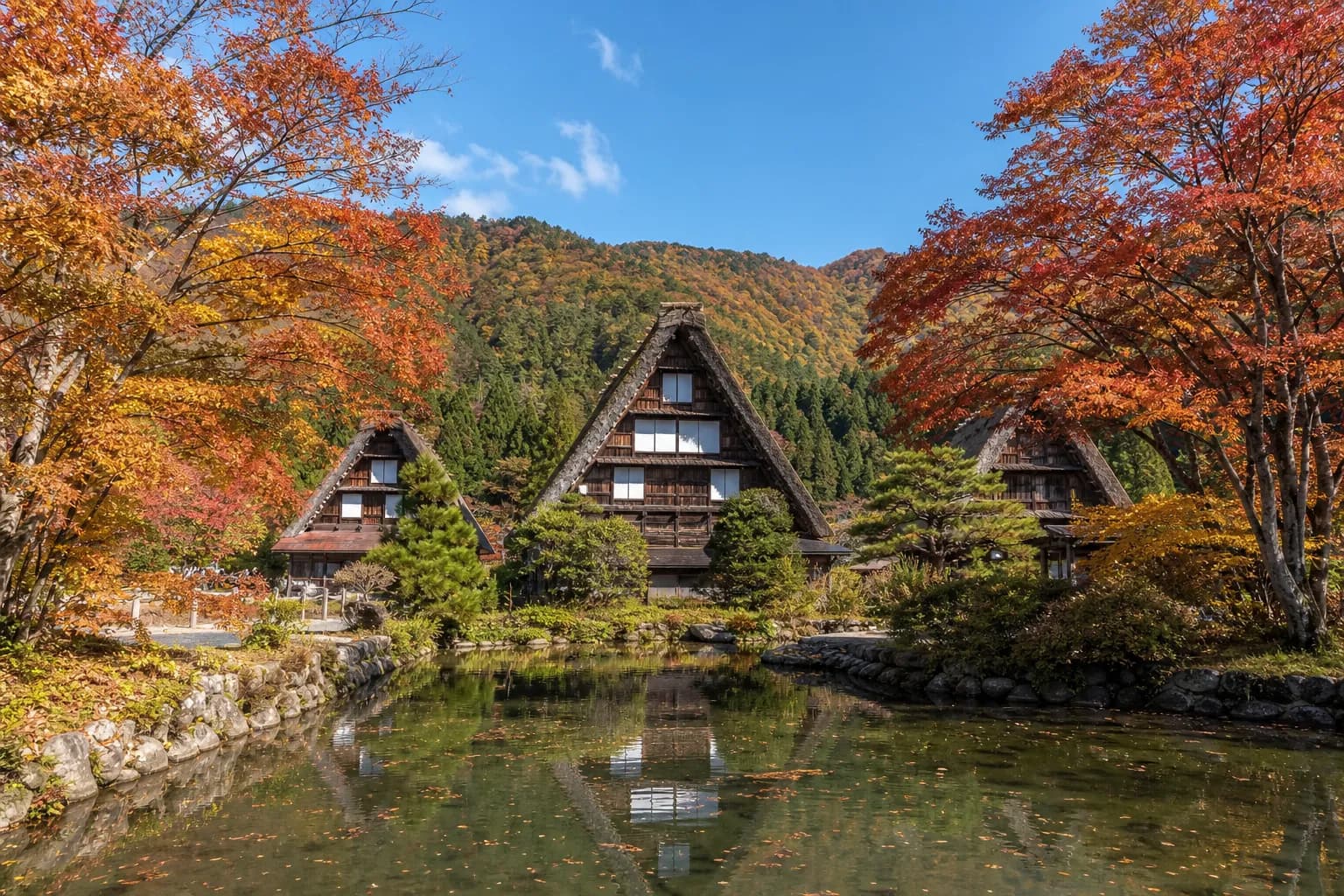
The name gassho-zukuri means "built like hands joined in prayer." Stand before one of these houses and you understand instantly. The steep triangular roof rises at roughly a sixty-degree pitch, like two palms pressed together at the fingertips.
This is not decoration. It is engineering shaped by snow.
Designed For A Brutal Winter
The Shogawa valley receives some of the heaviest snowfall in Japan. The sharp roof angle sheds snow before it can crush the timber. The vast attic spaces beneath once held silkworms — sericulture was a vital income source — with the open hearth below sending warm smoke upward to cure the thatch and keep insects away.
Perhaps the most remarkable detail: the frames are joined with rope and wooden pegs, not a single nail. That flexibility lets the structures flex during earthquakes instead of snapping. Watchful design, refined over generations.
A Roof Built By The Whole Village
Re-thatching one of these roofs is not a contractor's job. It demands two hundred or more people working together over a few days, under the old system of mutual aid known as yui. Neighbours owe one another labour, and they repay it.
This is the part most visitors miss. The houses are beautiful, yes. But they are also a record of a community that survived by cooperation. Understanding that changes how you walk through the lanes.
When To Visit: A Season-By-Season Reading
Shirakawa-go is genuinely a four-season destination, and each season offers something the others cannot. The mistake is treating them as interchangeable. They are not.
Winter — The Famous Snow Village
This is the image everyone knows. Farmhouses buried to their windowsills, snow stacked two to four metres deep, the whole valley turned the colour of paper. On a handful of select evenings in January and February, the village holds its light-up events, when the gassho houses glow against the dark mountains.
It is spectacular. It is also the most crowded time of year, and access tightens considerably. The illumination evenings now run on a reservation system to protect the village. Private, climate-controlled transport is not a luxury here so much as a necessity — public transport thins out fast, and roads can close.
Spring — Cherry Blossom And Flooded Paddies
From late April into early May, the valley wakes. Cherry trees bloom against the dark timber of the houses, and farmers flood the rice paddies for planting. The contrast — soft pink petals, hard wooden frames, mirror-still water — is quietly stunning.
Crowds are thinner than winter. Mornings bring mist off the fields. For photography, few moments in the year are better.
Summer — Deep Green And Living Agriculture
By summer the paddies are a saturated green and the village is fully at work. Long daylight hours give you room to explore the surrounding trails. The mountain air stays comfortable while the cities below swelter.
This is when Shirakawa-go feels least like a sightseeing stop and most like a working farming community — because that is exactly what it is.
Autumn — Foliage And Harvest
Mid to late October brings the surrounding peaks alive with red, orange and gold. The harvest is in full swing. The annual Doburoku Festival, held in October, celebrates the rice harvest with sacred unfiltered sake, folk songs and shrine performances rooted in centuries of tradition.
Cool, clear weather. Genuine cultural rhythm. Fewer crowds than the winter peak. For many of our guests, autumn is the connoisseur's choice.
Key fact: The winter illumination evenings are limited to roughly six dates per season and require advance reservation. Plan many months ahead, or consider autumn for similar atmosphere with far more breathing room.
Season-By-Season At A Glance
| Season | What Defines It | Best For | |---|---|---| | Winter (Jan–Feb) | Deep snow, illumination evenings | The iconic image; accept the crowds | | Spring (late Apr–May) | Cherry blossom, flooded paddies | Photography, mild weather | | Summer (Jun–Aug) | Lush green, long days | Hiking, living farm life | | Autumn (Oct) | Foliage, Doburoku Festival | Culture without the winter rush |
How To Experience The Village Beyond The Crowds
Here is the honest truth about Shirakawa-go. By day, it is busy. Coach parties roll in from Kanazawa and Takayama, the main lane fills, and the silence we described at the start vanishes entirely.
The valley reveals its real self in the margins of the day. Early morning, before the buses. Late afternoon, after they leave. These are the hours that matter.
Stay The Night If You Can
A small number of gassho-zukuri farmhouses operate as minshuku — family-run guesthouses where you sleep inside one of these very buildings, share a hearth-cooked dinner, and wake to a near-empty village. Rooms are simple and deeply atmospheric. They sell out far in advance.
For those who prefer a higher tier of comfort, basing in Kanazawa or Takayama and travelling in privately at the right hours gives you the best of both: refined accommodation and the quiet village. Our concierge team can advise on which arrangement fits your party.
The Ogimachi Viewpoint
The Shiroyama viewpoint above Ogimachi offers the classic panorama of the whole settlement laid out among the fields and mountains. It is justly famous. Arrive early, and you may have it nearly to yourself before the day-trippers reach it.
Read The Houses You Enter
Several farmhouses are open to visitors, including the large Wada House, once home to a prosperous family of village leaders. Walking through with someone who can explain the silkworm lofts, the hearth, the joinery — rather than glancing and moving on — is the difference between a photo stop and an understanding of how this place lived.
Pairing Shirakawa-go With The Wider Region
Shirakawa-go works beautifully as one movement in a larger journey rather than a standalone errand. The natural pairing is Kanazawa — with its samurai and geisha districts, the celebrated Kenroku-en garden, and a serious crafts tradition in gold leaf and lacquer.
Takayama, on the other side, offers a wonderfully preserved old merchant town and an excellent morning market. Many of our guests thread all three together with private chauffeured transfers, letting the drive through the mountains become part of the experience rather than dead time.
If you are building a broader itinerary, our writing on the best places to go in Japan sets out how a region like this fits into a longer, considered route.
Practical Questions Travelers Ask
How Long Should I Spend In Shirakawa-go?
A half-day covers the essentials. But to feel the village properly — the quiet hours, a farmhouse interior, the viewpoint without crowds — give it a full day, or stay overnight.
Is It Worth Visiting In Winter Despite The Crowds?
If the snow-buried village is your dream image, yes. Just plan early, secure illumination-evening arrangements well ahead, and rely on private transport. Public access constricts sharply in deep snow.
Can I Combine It With Kanazawa And Takayama?
Easily, and we recommend it. Both are within roughly ninety minutes by road, and a private vehicle lets you set your own timing around the bus crowds.
Do People Still Live In The Farmhouses?
Yes. Shirakawa-go is an inhabited village, not an open-air museum. That is exactly why respectful, quiet visiting matters so much.
Why Choose Japan Royal Service
Shirakawa-go is easy to reach and easy to get wrong. The default experience — arrive at noon, fight the crowd, leave — misses almost everything that makes the valley worth the journey.
Our work at Japan Royal Service is to give you the other version. We design private chauffeured journeys through Gifu and the surrounding Hokuriku region using our flagship fleet, from the Lexus LM and Toyota Alphard to executive vans for larger parties, so the mountain roads become a pleasure rather than a logistics problem. We time your arrival for the quiet hours. We can introduce you, where appropriate, to the farmhouses and craftspeople whose work gives this region its wabi-sabi soul — the beauty that lives in worn timber, hand-cut thatch, and the patient labour of generations of shokunin.
And we do it with complete discretion. Your itinerary, your party, your presence in the valley — these remain entirely private. For travelers who value substance over spectacle, that quiet care is the whole point.
If you would like to weave Shirakawa-go into a tailored journey through Kanazawa, Takayama and beyond, our concierge team is ready to help. Contact Japan Royal Service for a private, no-obligation conversation, or reach us directly via WhatsApp. Let us show you the village that the day-trippers never see.