Nature
The Luxury of Biei: A Private Nature Guide
Discover Biei Japan's stunning flower fields, iconic Blue Pond, and seasonal beauty. Expert guide to experiencing Hokkaido's most picturesque town.
At 6:12 a.m. in late July, I eased off Panorama Road and watched fog peel away from the potato rows. Cold air. Hills holding their breath. Biei, Japan sits in Hokkaido’s farm country, about 30 kilometers from Asahikawa, and it still reads like a working town first—until you notice that, on certain mornings, lenses and tripods gather faster than tractors when the light stripes the slopes into green, yellow, and damp brown. Years back, it felt like a plain agricultural stopover; now it pulls in travelers who want room, quiet, and a pared-back wabi-sabi feel without theme-park shine, plus the patchwork fields, the lone trees everyone argues over, and the Blue Pond’s strange glow when the sun finally muscles through.
The Distinctive Landscape That Defines Biei, Japan
Biei’s terrain does the talking. Small rises. Quick drops. The hills don’t lounge flat like other farm basins in Japan; they cant and fold, so even an ordinary wheat field suddenly has depth, moving shadow, and a sharper sense of how far the road really runs.
Patchwork Road and Panorama Road are the two drives people mention most. They’re simple lines on a map, yet the view keeps slipping into something new, and the “best” stop is often the next curve you didn’t circle in advance:
- Patchwork Road: Tighter plots, uneven borders, a quilt-like read
- Panorama Road: Broader sightlines across larger fields
- Seasonal rotation: Crops rotate, so the colors refuse to hold still
- Photography opportunities: Pullouts and bends that whisper “one more”
The Biei Tourism Association provides detailed information on routes and timing, and it’s genuinely handy—especially if you’re chasing a particular crop color before harvest wipes it clean. Still, rotation here isn’t staged for visitors; it’s farm math, and the side effect is that the palette can flip between weeks, which is how you show up expecting last year’s postcard and get something moodier, darker, or oddly muted instead.
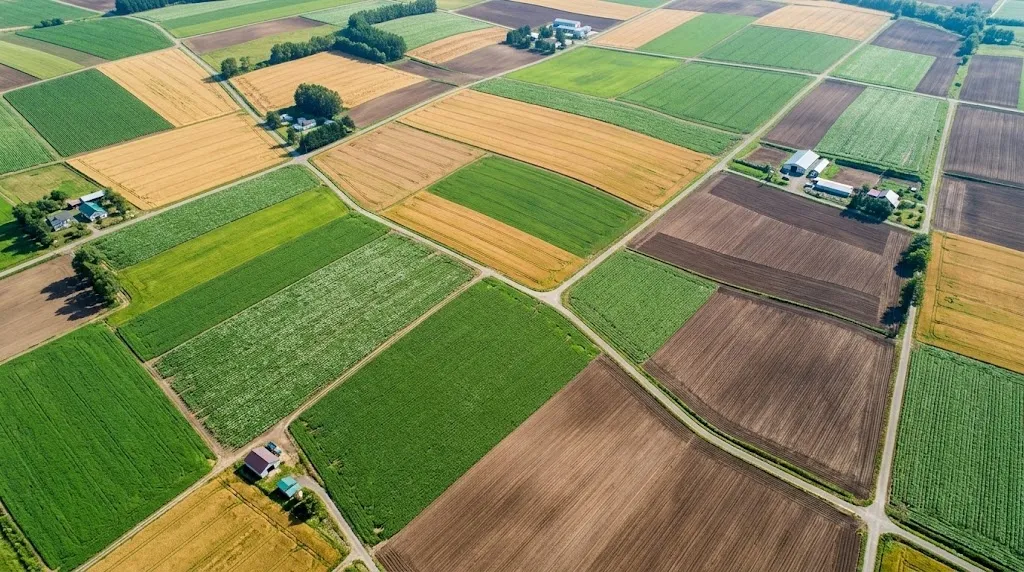
You can see the steady hand of Biei’s farmers: each field is practical, and together they land as crisp, multi-colored geometry across the hills.
Iconic Trees and Natural Landmarks
Yes, the trees are “famous.” Sounds goofy. Then you stand there. One trunk on a slope, a bit of wind worrying the leaves, and you get why photographers keep returning to the same solitary shapes against open sky, even when the parking feels slightly ridiculous.
| Tree Name | Location | Notable Feature | Best Season | |---|---|---|---| | Ken and Mary Tree | Patchwork Road | Featured in a 1972 commercial | Summer | | Seven Star Tree | Panorama Road | Appeared on cigarette packaging | All seasons | | Parent and Child Tree | Near Panorama Road | Three oak trees symbolize family | Autumn | | Philosopher’s Tree | (Removed 2016) | Historical significance remains | N/A |
What lands, over and over, is how much Biei leans on restraint: open ground, one subject, and the willingness to let weather call the shots instead of installing loud attractions to explain what you’re “supposed” to feel.
The Blue Pond: Biei, Japan's Aquatic Jewel
No single spot pushes Biei’s name farther than the Blue Pond (Aoiike). Short walk. Hard stop. It’s an artificial pond, formed in 1988 during erosion control work after Mount Tokachi’s eruption, and that accidental backstory is a big part of why it sticks—nobody set out to build something “pretty,” it just ended up looking unreal.
The blue tone comes from aluminum hydroxide particles suspended in the water, scattering light in a way that reads as turquoise, especially when the sun is direct. It shifts fast. The Blue Pond's otherworldly appearance is real, but it isn’t reliable: clouds dull it, wind roughs it up, and the season changes what the surrounding trees bounce back onto the surface—sometimes you get a clean color, sometimes a broody, gray-blue wash that feels nothing like the photos.
Visiting the Blue Pond Throughout the Year
Each season nudges the scene in its own direction:
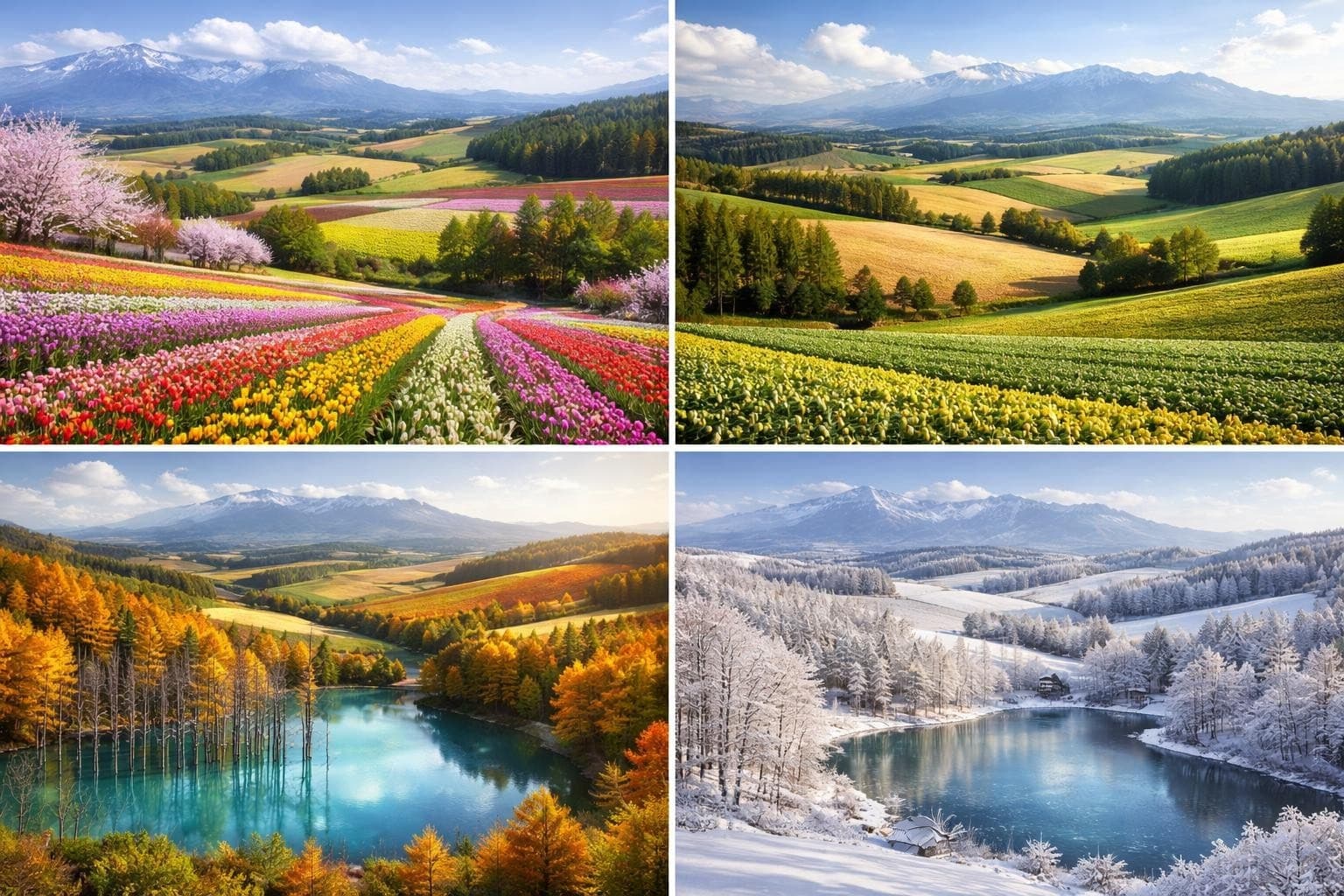
Spring and Summer (May-August): This is when the turquoise reads strongest under direct sun. The silver birches turn green, and the contrast comes off clean and sharp.
Autumn (September-November): Leaves warm up, reflections go coppery, and the water stays cool-toned, which makes shots feel more layered.
Winter (December-March): Parts freeze. Not all of it. Evening illumination events turn the area into a quiet light display that can feel almost hushed if you arrive after the first rush thins out.
There are clear paths, viewing decks, and basic facilities, and they keep things in line without turning it into a circus. If you can manage it, go early—before 8:00 a.m. is the sweet spot—because the gap between an empty deck and a shoulder-to-shoulder queue is the gap between hearing wind in the trees and hearing, “Can you move a little?” Big mistake: arriving at midday in August and expecting stillness.
Shikisai Hill: A Cultivated Paradise
Shikisai Hill is Biei’s more intentional face. It’s not a fluke. It’s planted, tended, and timed, spread across 15 hectares of rolling ground so the color bands show from far off when the sky cooperates and the light isn’t flat.
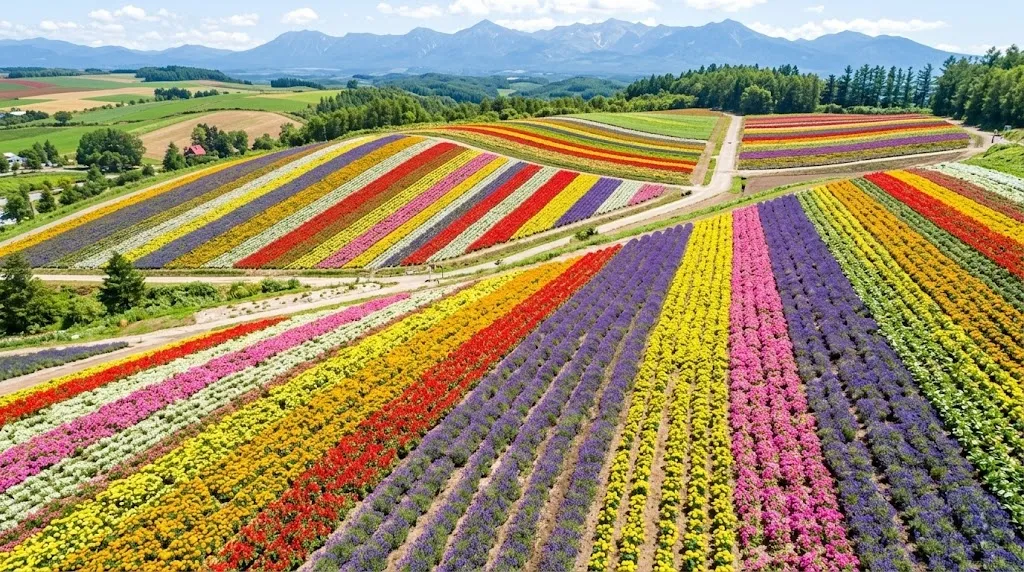
From above, the flower fields read like long, cultivated ribbons spilling over the hills at Shikisai Hill.
The bloom schedule is set up for continuity, so there’s usually something worth the stop from late April into October:
- Early Season (April-May): Tulips and pansies take the front seat
- Peak Summer (June-August): Lavender, lupines, and California poppies crowd in with the densest color
- Late Season (September-October): Sunflowers, cosmos, and salvias keep the wheels turning
Premium experiences at Shikisai Hill include:
- Tractor-pulled buggy rides offering panoramic perspectives
- Alpaca farm interactions within the flower field complex
- Agricultural product shopping featuring local vegetables and processed goods
- Professional photography guidance during optimal light conditions
The detailed seasonal information on attractions like Shikisai Hill helps you line up bloom timing with flights and hotel nights, especially if you hate gambling on weather. If you’re traveling as a pair or a small party of four, it’s also easier to pivot when the sky flips—Hokkaido clouds don’t negotiate, and a plan that looked smart at breakfast can feel silly by 11:00.
Culinary Excellence in Bie, Japan
Biei’s food story starts in the dirt. Plain truth. Volcanic soil, clean water, and big temperature swings push ingredients toward a firmer sweetness and a more outspoken flavor than you’d guess from a quiet farming town.
Signature Agricultural Products
Biei wheat gets plenty of attention, and it isn’t just local pride; its flour shows up with artisan bakers across Japan. A few known spots turn that farm abundance into meals that feel seasonal without being fussy—shun in a practical, not precious, way—and you notice it most when the plate tastes like it came from just over the next hill.
- Ferme La Terre Biei: French-Japanese fusion cuisine using exclusively local ingredients
- Biei Senka: Wheat-based products such as bread and pastries
- Restaurant Asperges: Seasonal vegetables presented in elegant multi-course style
| Product Category | Premium Examples | Seasonal Availability | |---|---|---| | Vegetables | Asparagus, corn, potatoes | May-October | | Dairy | Artisan cheeses, soft-serve ice cream | Year-round | | Grains | Biei wheat flour, barley products | Year-round (harvested August-September) | | Processed Goods | Jams, pickles, wheat snacks | Year-round |
Done well, a meal here can feel as dialed as dining in a larger city, but with one unfair advantage: you’re close to the source, so you look out at fields first and taste what came from them second, and the connection lands in your mouth before anyone tries to explain it.
Planning Your Luxury Visit to Biei, Japan
Biei is easy to fall for, but it’s not frictionless. Tight windows. Real distances. If you’re aiming for comfort and an unhurried pace, think through transport before you start saving viewpoints like trading cards, because the day can unravel fast when a parking lot fills or a rain band sits down on the hills.
Transportation and Accessibility
Primary access routes include:
- Asahikawa Airport (30 kilometers): The closest airport with connections to Tokyo (Haneda) and Osaka
- JR Biei Station: Accessible via limited express trains from Sapporo (approximately 2.5 hours)
- Private vehicle: Essential for exploring the scenic routes and accessing remote viewpoints
Public transit can work, yet the gaps show up exactly when you want to chase light or dodge weather. With a private car service, you’re not stuck staring at a timetable while the clouds split open; you move when the sky says “now,” and a local driver can smooth out seasonal road quirks, small parking puzzles, and the polite, unspoken rules around farms (the kind nobody writes down). Nico from JRS once did this on a late-July morning, our party of four headed next toward Shirogane Onsen: we waited about seven minutes for a pullout to clear, he pointed at a hand-painted sign that read “畑に入らないで,” and he said—half in English, half under his breath—“This is the shot… without stepping in.” Worth it.
Optimal Visiting Seasons
Each season in Biei changes the mood:
Summer (June-August) offers the greatest flower diversity, the clearest Blue Pond color on sunny days, and temperatures around 20-25°C. It also brings thicker crowds, especially around Japanese school holidays, when the roadside pullouts fill fast and you might circle once—sometimes twice—before you land a space.
Autumn (September-November) is calmer, with harvest energy and deeper tones in the landscape; golden fields against turning trees create a look you can’t counterfeit in other months.
Winter (December-March) turns everything into white space, and that emptiness is the point. The Blue Pond illumination, diamond dust phenomena, and snow-covered patchwork hills suit travelers who like cold air and clean lines, even if your gloves are a little too thin.
Spring (April-May) is in-between—snow pulls back, greens return, and early flowers show up, sometimes in the same frame as lingering frost you didn’t expect to see.
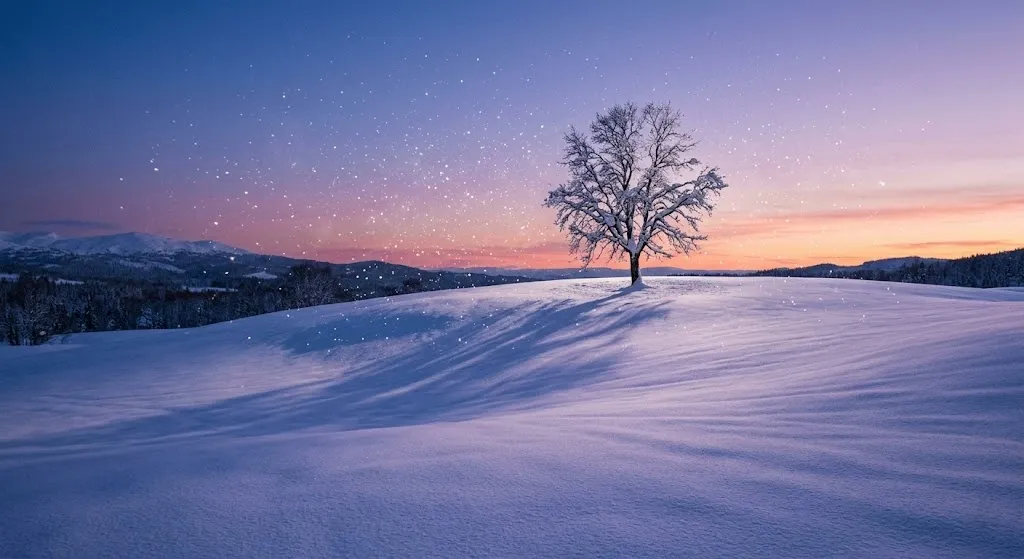
A spare winter scene: a lone tree, deep snow, and diamond dust glittering in the air on a cold Biei evening.
Accommodation Options for Discerning Travelers
Biei is small. That’s the charm. Lodging has grown up around it, though, and you can now sleep near the fields without giving up comfort, heat that actually works, or a truly quiet night.
Premium Lodging Categories
Boutique farm stays lean into the rural setting while keeping the essentials crisp. Expect a slower rhythm, plus the kind of omotenashi that feels real because it’s personal, not performed—someone notices you’re up early and leaves the hallway a bit quieter.
- Spacious rooms with panoramic countryside views
- Private bathing facilities, often using local spring water
- Multi-course dinners featuring estate-grown ingredients
- Personalized service from owner-operators who share deep local knowledge
Luxury ryokan in nearby Asahikawa add a traditional layer—onsen time, kaiseki pacing, and a comfortable base with straightforward access to Bi,ei Japan when you roll out early.
Exclusive rental villas are also part of the picture for travelers who want full privacy, a kitchen, and room for family or friends to sprawl, especially when weather pins you indoors for a quiet night and you end up listening to rain instead of chasing views.
Photography and Art in Biei, Japan
Biei’s look has drawn photographers since the 1970s, after landscape photographer Shinzo Maeda’s work helped put it on the national radar. That legacy still steers how people move here—slow drives, frequent stops, and a lot of waiting for the sky to stop being stubborn.
Capturing the Perfect Shot
Optimal photography conditions come down to light and timing, plus a bit of humility about weather:
- Golden hour: Sunrise and sunset angle light across the hills and pull out texture
- Cloudy days: Soft light can make the Blue Pond read deeper in color
- Post-rain conditions: Air clarity improves, and wet ground darkens tones for contrast
- Winter mornings: Low sun throws long shadows over the snow
Guides who focus on photography can be a quiet advantage, especially if your schedule is tight and you can’t afford to “miss” the one clear window. They watch forecasts, shuffle the order of stops, and sometimes know a tucked-away viewpoint that keeps you off the roadside, which matters when farm traffic is moving and you don’t want to be that person with a door hanging open in the lane. And yes, sometimes the “perfect” shot never shows. That’s Biei, too.
Cultural Integration and Sustainable Tourism
Tourism here has friction. Real farms. Real work hours. Biei isn’t a resort built around guests; it’s an agricultural community where visitors are, in a very literal way, borrowing the scenery while someone else is trying to plant, spray, cut, and haul.
Responsible travel practices include:
- Respecting private agricultural land and viewing designated areas only
- Supporting local businesses through purchases of regional products
- Understanding seasonal farming activities and avoiding disruption
- Participating in agritourism experiences that benefit farming families directly.
The comprehensive resources from the Japan National Tourism Organization focus on sustainable engagement with rural communities, and the advice boils down to common sense: stay on the paths, don’t treat fields like props, and remember that shokunin pride shows up here as much in farming as it does in craft, even if the “workshop” is a tractor shed.
Beyond the Highlights: Hidden Experiences
If you only stop at the famous pullouts, you’ll get the headline Biei. Step a little wider. Slow down. The quieter corners can feel more like the real place than the spots everyone already memorized from their phone wallpaper.
Lesser-Known Locations
Bibaushi Hill offers a similar patchwork view with fewer people clustering at the rail. Farmers have set up observation areas so visitors can look without getting in the way, and that boundary isn’t just manners—it’s the line between viewing a field and walking into someone’s job.
Zerubu Hill has wildflower meadows and a working-farm vibe, plus a produce stand in harvest season that keeps things plainspoken and friendly, the kind of stop where you hear a quick “arigato” and you’re back in the car with dirt still on the vegetables.
Shirogane Onsen area is more than the Blue Pond; it includes hot springs, forest trails, and the Shirahige Waterfall, where mineral-rich water drops into the Biei River and leaves a blue streak in the rush that you can catch even when the day stays overcast and your photos look flatter than you hoped.
Integrating Biei, Japan, and Into Broader Hokkaido Itineraries
Many luxury travelers fold Biei into a larger Hokkaido loop rather than treating it as a single-purpose stop. That structure helps, because distances are real, weather can turn moody without warning, and the best moments often happen between “major” sights—when you have enough breathing room to pull over, kill the engine, and just look.
Complementary destinations within reasonable proximity include:
- Furano (25 kilometers): Famous for lavender fields and additional agricultural tourism
- Asahikawa (30 kilometers): Hokkaido's second-largest city, offering urban amenities and the renowned Asahiyama Zoo
- Daisetsuzan National Park (50 kilometers): Japan's largest national park with pristine wilderness and hiking opportunities
- Sounkyo Gorge (70 kilometers): Dramatic canyon scenery and onsen resort villages
A 7-10-day Hokkaido plan usually gives Biei enough time to feel unhurried, while still leaving room for nearby cities and wilder terrain. With premium transport, transitions stay comfortable and flexible, and that flexibility matters when a clear morning appears out of nowhere and you decide—on the fly—to flip the day’s order and chase the light before it closes again.
The Artistic Legacy and Contemporary Culture
Art and landscape are tightly linked in Bi,ei Japan’s modern identity. It attracts photographers, painters, and writers who like quiet subjects, and the cultural scene stays understated—more small galleries and workshops than big, loud events built to swallow crowds.
Local spaces show landscape photography and paintings of the hills, and artisan studios produce ceramics, textiles, and woodwork that echo the farm aesthetic without straining for attention. Those stops add heft to a visit, shifting it from “we checked the viewpoints” to something closer to learning the place’s texture, pace, and everyday craft, with wabi-sabi showing up in the small imperfections that make pieces feel lived-in.
The yearly calendar brings harvest festivals, photography contests, and seasonal celebrations where visitors can join without taking over. If you want something more grounded than standard tourist programming, these community moments can end up feeling like the most honest hours of the trip. Not always pretty. Often true.
Biei, Japan pairs open landscapes with farm authenticity and a strong visual pull, especially along the patchwork roads and at the Blue Pond. It works best when you travel with patience, respect for working land, and enough slack in the day to follow light and weather instead of trying to bully them into place. When you're ready to experience Biei with close attention and tailored pacing, Japan Royal Service designs bespoke itineraries that match seasonal highlights, secure premium experiences, and provide luxury transportation across Hokkaido without the usual logistical strain.