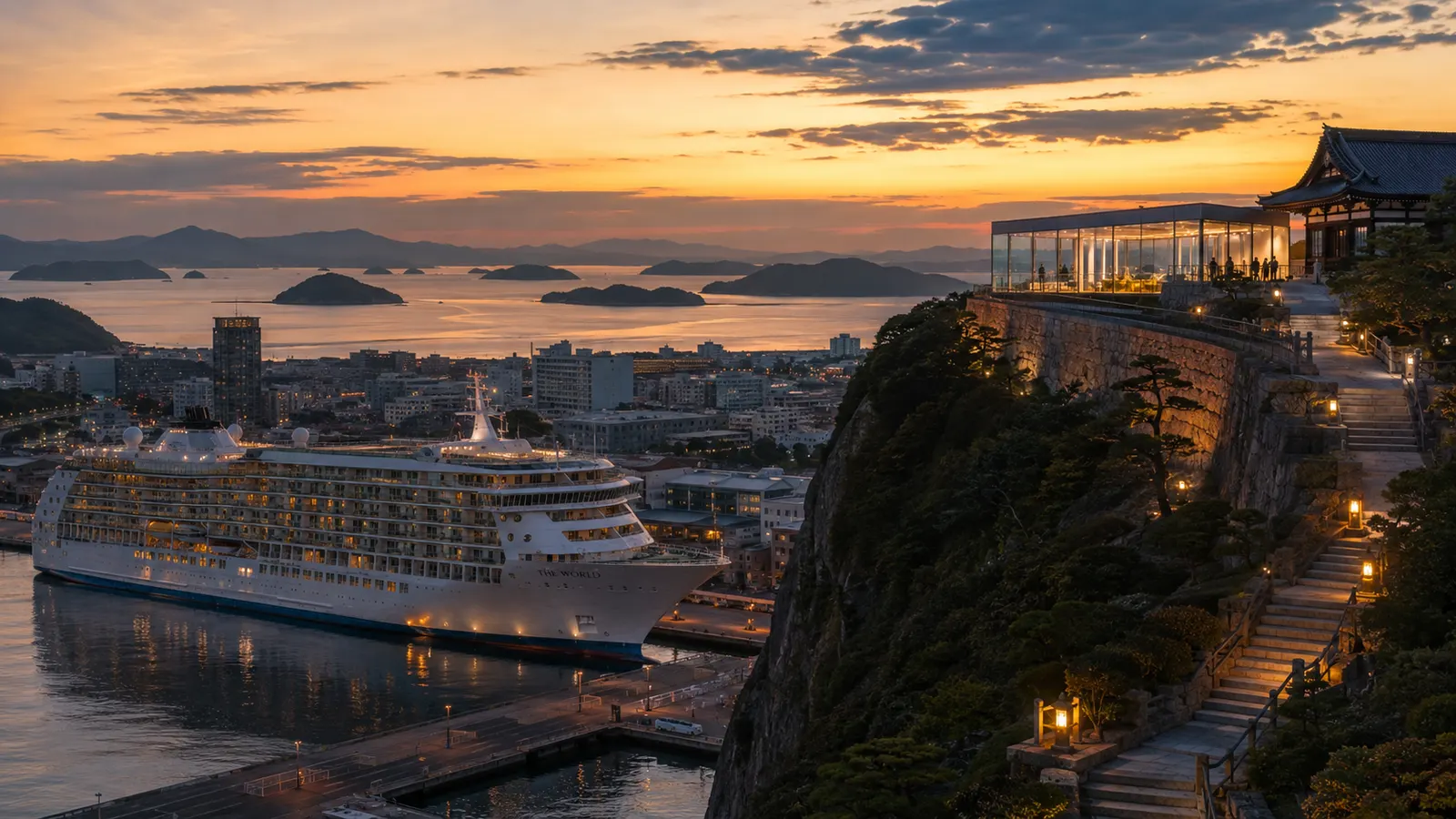
A Takamatsu call, as most itineraries draw it, means early arrival and evening departure — roughly ten hours ashore. An evening on Yashima does not fit inside that window, and it is better to say so at the top of the page than to bury it beneath the scenery. The plateau's finest hour is the one after the last visitor has left, when the light goes off the Inland Sea and the city lifts into view beneath you. To be there for it, you need an overnight call at Takamatsu, or a materially late sailing. Framed honestly, this is less a description of a viewpoint than an argument for staying the night — which is the more useful thing to know anyway.
What follows is the case for it.
The western rim at dusk
Stand at Shishi-no-Reigan, on the western edge of the plateau, in the last half-hour of daylight. The sun goes down over the Inland Sea, and Takamatsu comes up beneath you — and there is no gap between the two events. The sunset dissolves into the nightscape without an interval, one continuous transition that Japanese sources call a yūyakei, a sunset-and-nightscape, and note as nationally unusual. The sunset here is counted among Japan's hundred finest; the viewpoint carries a Japan Night View Heritage designation. Most places give you one or the other. Yashima gives you both in a single unbroken movement, and that continuity is the whole reason to be up here at this hour.
You are watching it from roughly 292 metres above the sea, on the flat top of a lava mesa — and the flatness is not incidental.
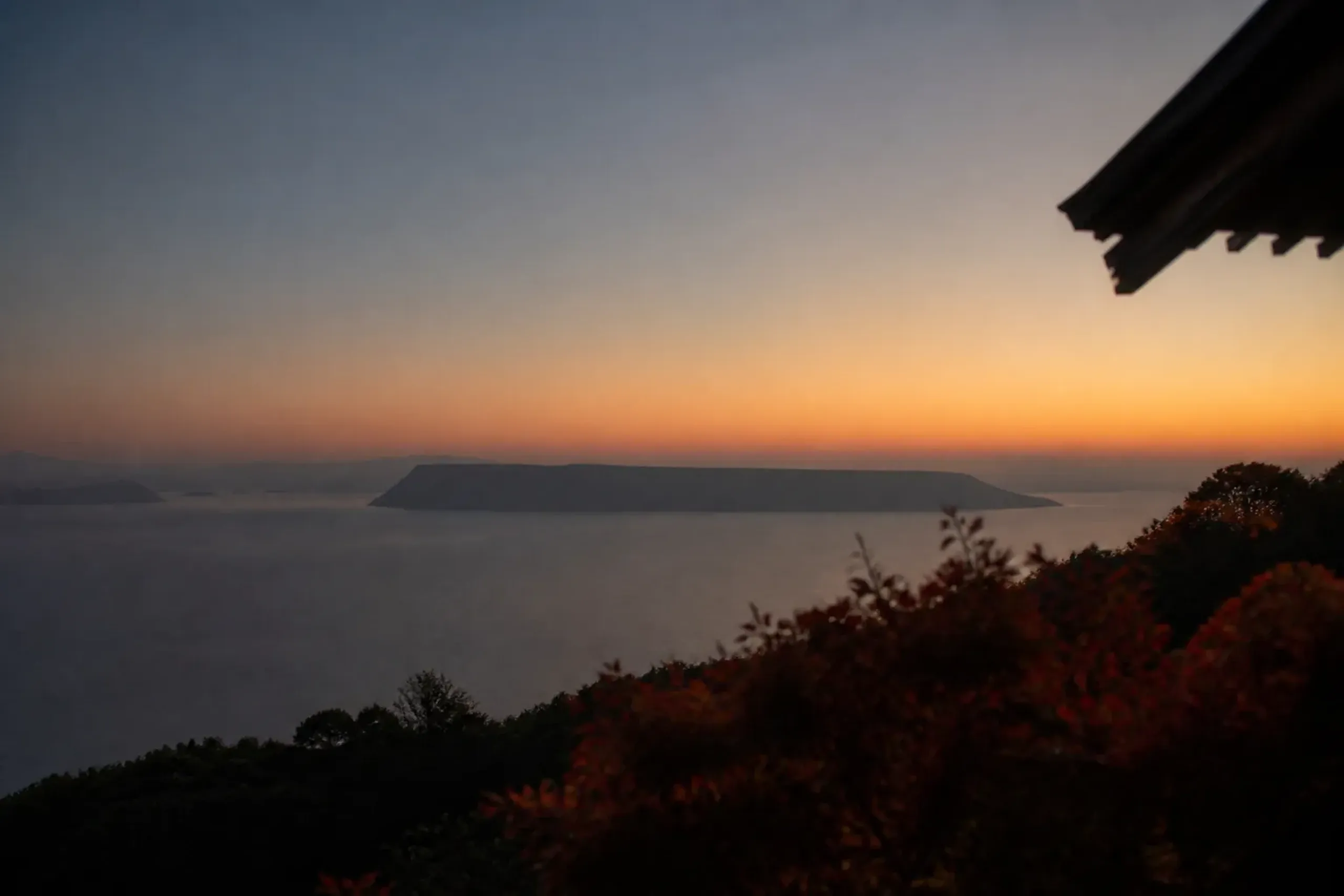
It is why a fleet sheltered beneath this mountain in 1185, and why two families deciding who would rule Japan chose to fight here. Eight hundred years of that history sits inside the same frame as the city lights: a seventh-century fortress, a twelfth-century battlefield, an eighth-century temple, and the present-day glow of Takamatsu, all held in one view as the dark comes on.
The constraint, stated plainly
Because it bears repeating in its own section: the standard Takamatsu port day does not accommodate an evening on Yashima. Sunset over the Inland Sea is the product here, and a mid-afternoon departure takes it off the table entirely. An overnight call, or a sailing pushed materially late into the night, is the prerequisite. Everything below assumes you have the evening to give it.
What Yashima is
Yashima is a lava mesa, roughly five kilometres north to south and two east to west, named for its resemblance to a roof (yashima, eight roofs). Until the early Edo period it was a true island, joined to the mainland only later. It sits within Setonaikai National Park — Japan's first national park — and is designated both a National Historic Site and a Natural Monument.
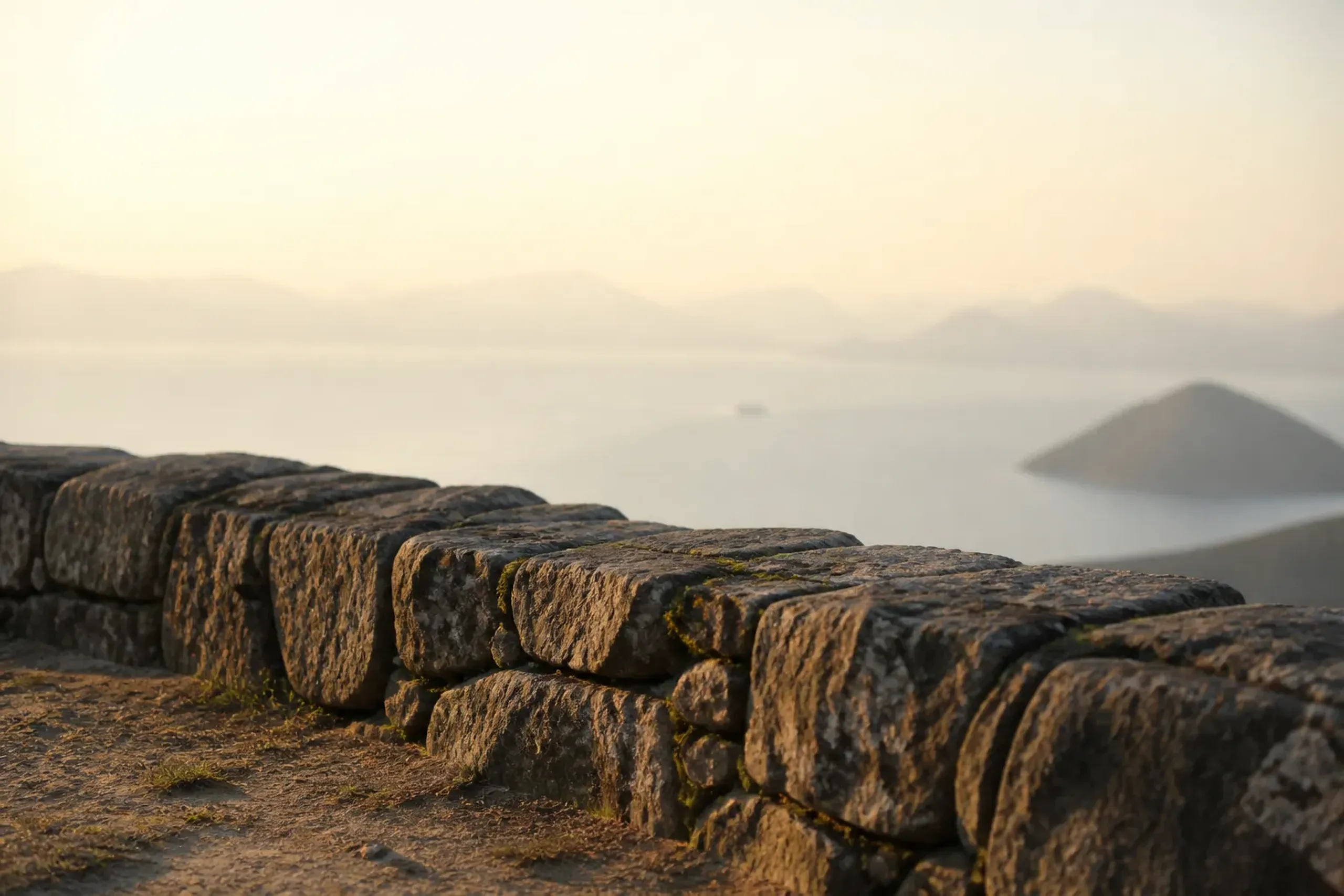
The mountain's flat crown has been useful to soldiers for more than thirteen centuries. In 667, after the defeat at the Battle of Baekgang, the fortress of Yashima-no-ki was raised here against a feared invasion from the continent; the Nihon Shoki records its building, and stone walls survive on the plateau to this day.
Five centuries later, in 1185, this was the site of the Battle of Yashima, one of the closing engagements of the Genpei War. The Taira had come by sea; the Minamoto came overland and appeared where they were not expected. Surviving sites include Funakakushi, where the Taira concealed their warships, and Inori-iwa, where the archer Nasu no Yoichi is said to have prayed before the episode every Japanese schoolchild knows — a fan set on the mast of a Taira boat as a taunt, and the order to strike it from horseback in a moving sea. He did. Standing on the rim with the water below, the geography of the battle explains itself in about a minute, which is more than can be said for most battlefields.
Yashima-ji
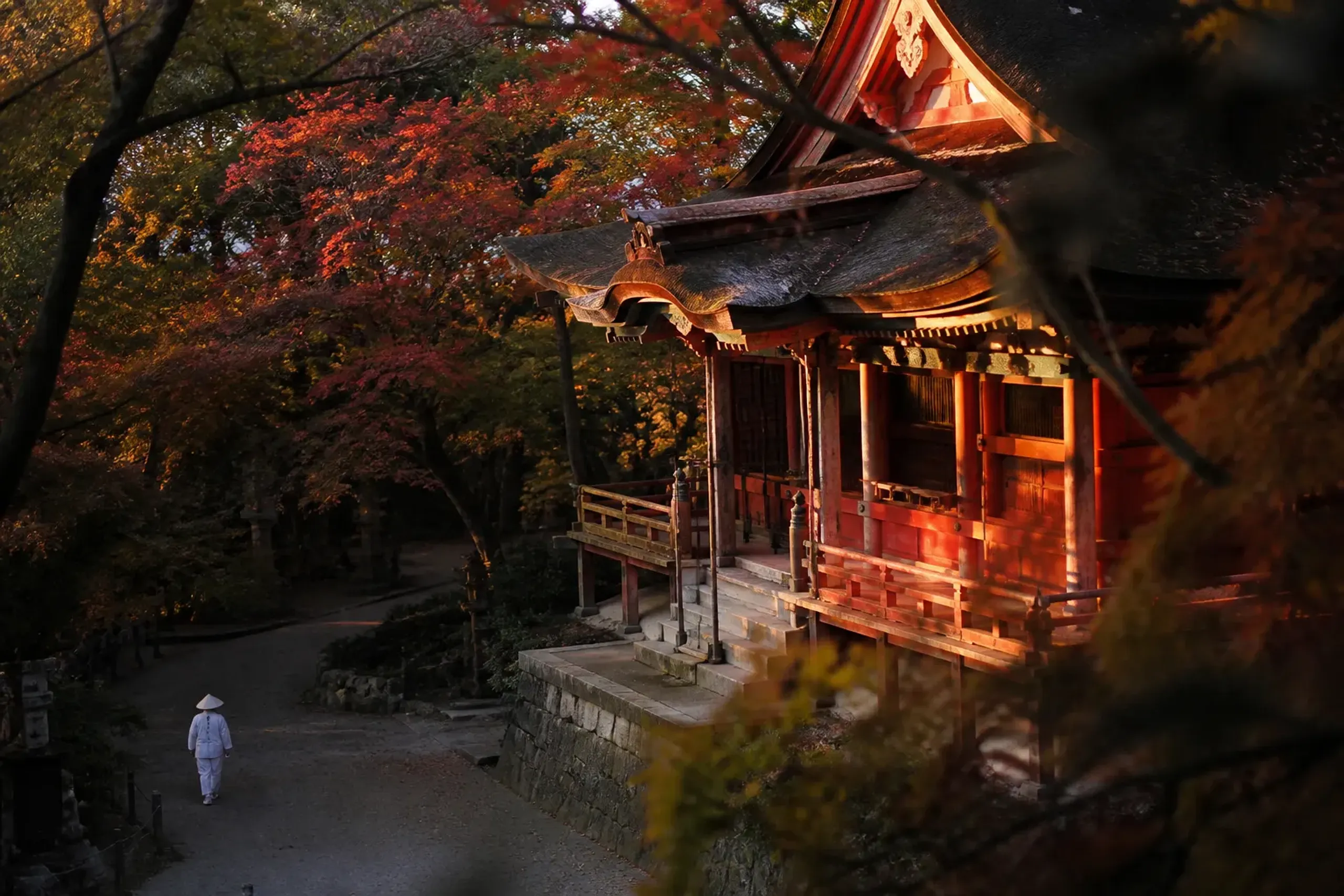
Near the summit stands Yashima-ji, the eighty-fourth temple of the Shikoku pilgrimage, traditionally founded in the eighth century by the Chinese monk Ganjin — the same Ganjin who, after five failed crossings and the loss of his sight, finally reached Japan and reshaped its Buddhism. Its vermilion main hall and its seated Eleven-Headed Thousand-Armed Kannon are Important Cultural Properties, and its treasure hall holds Genpei-era scrolls and screens and material from the centuries after the battle. It remains an active pilgrimage temple — visited with the quiet that status asks for, never treated as a venue.
The three viewpoints
The plateau offers three principal outlooks, each turned to a different subject.
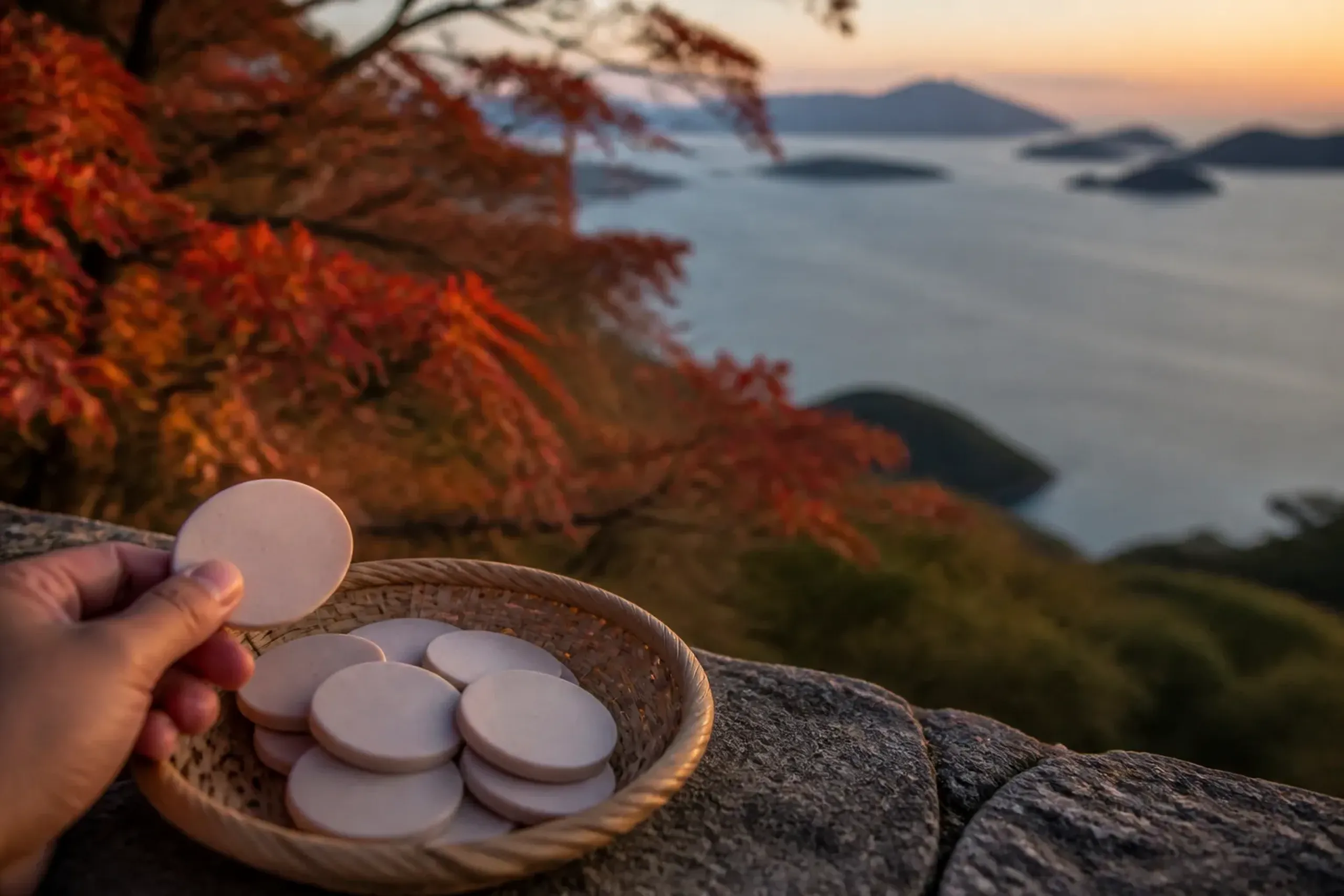
- Shishi-no-Reigan, to the west — the sunset and the city, and the continuous transition between them. This is the evening's centre. Kawarake-nage, the throwing of small unglazed clay discs from the rim, is a long-standing custom here, and should be done only at this designated place.
- Dankōrei, to the east — looking down over the Danno-ura battlefield and across to the Aji quarries on Gokenzan. That same Aji stone, quarried within sight of this viewpoint, roofs the building at the summit. It is worth reading about the stone and its masters before you stand here and see where it comes from.
- Yūkakutei, at the northern tip — the outlook over the sea to the north.
Yashimaru and the Aji stone roof
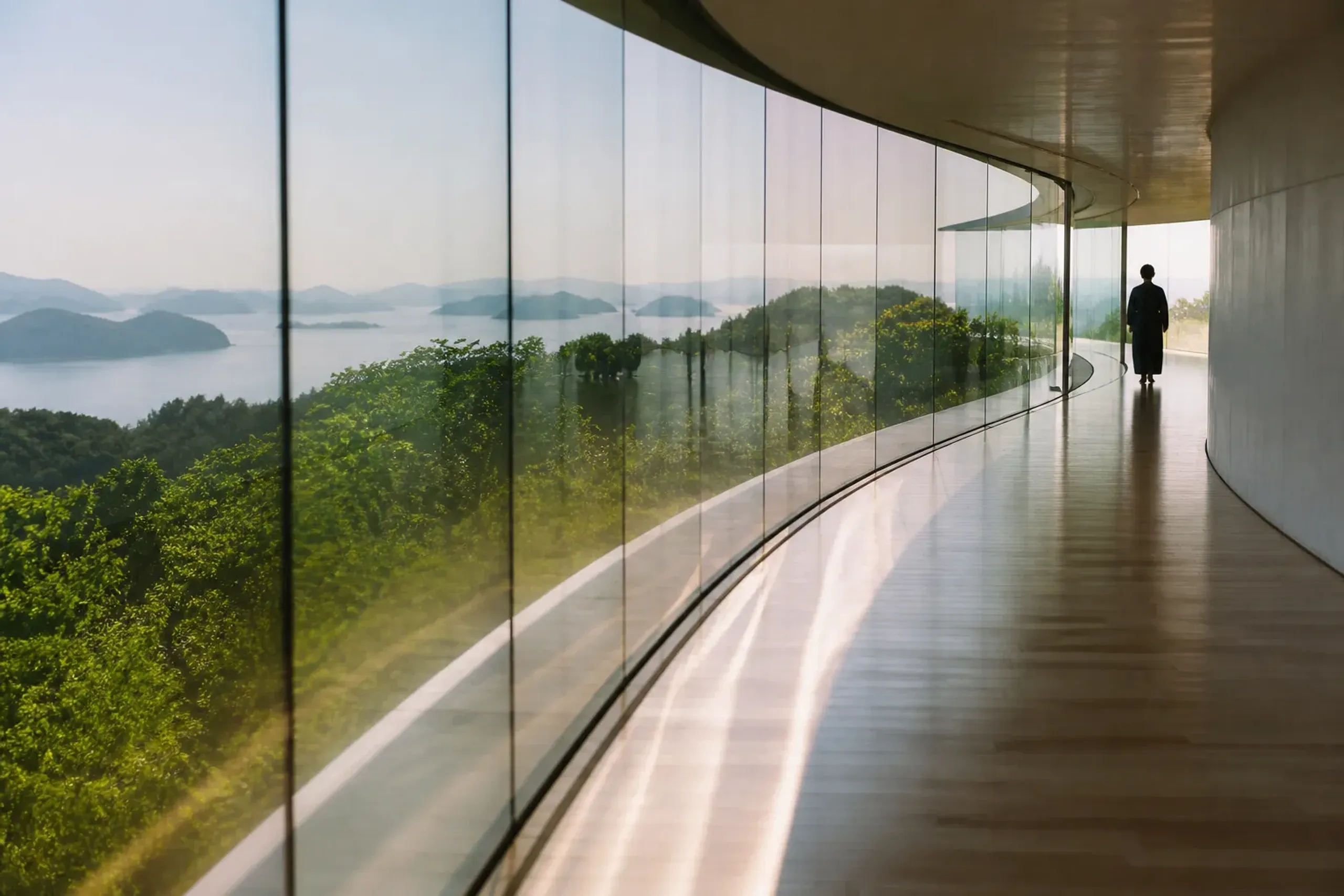
The observation building on the summit — the Takamatsu City Yashima Mountaintop Hub, known as Yashimaru — opened on 5 August 2022 as a work of the Setouchi Triennale. It is a curved corridor of roughly two hundred metres, glass-walled, rising and falling with the ground rather than sitting on top of it. Inside, the corridor bends so that the sea appears, disappears and returns as you walk — the architecture doing to the Inland Sea what the old garden-makers did to a borrowed mountain.
Its roof is laid in tiles of Aji stone, the prized granite worked in the quarries visible from Dankōrei, and the surface shifts colour with the light through the day.
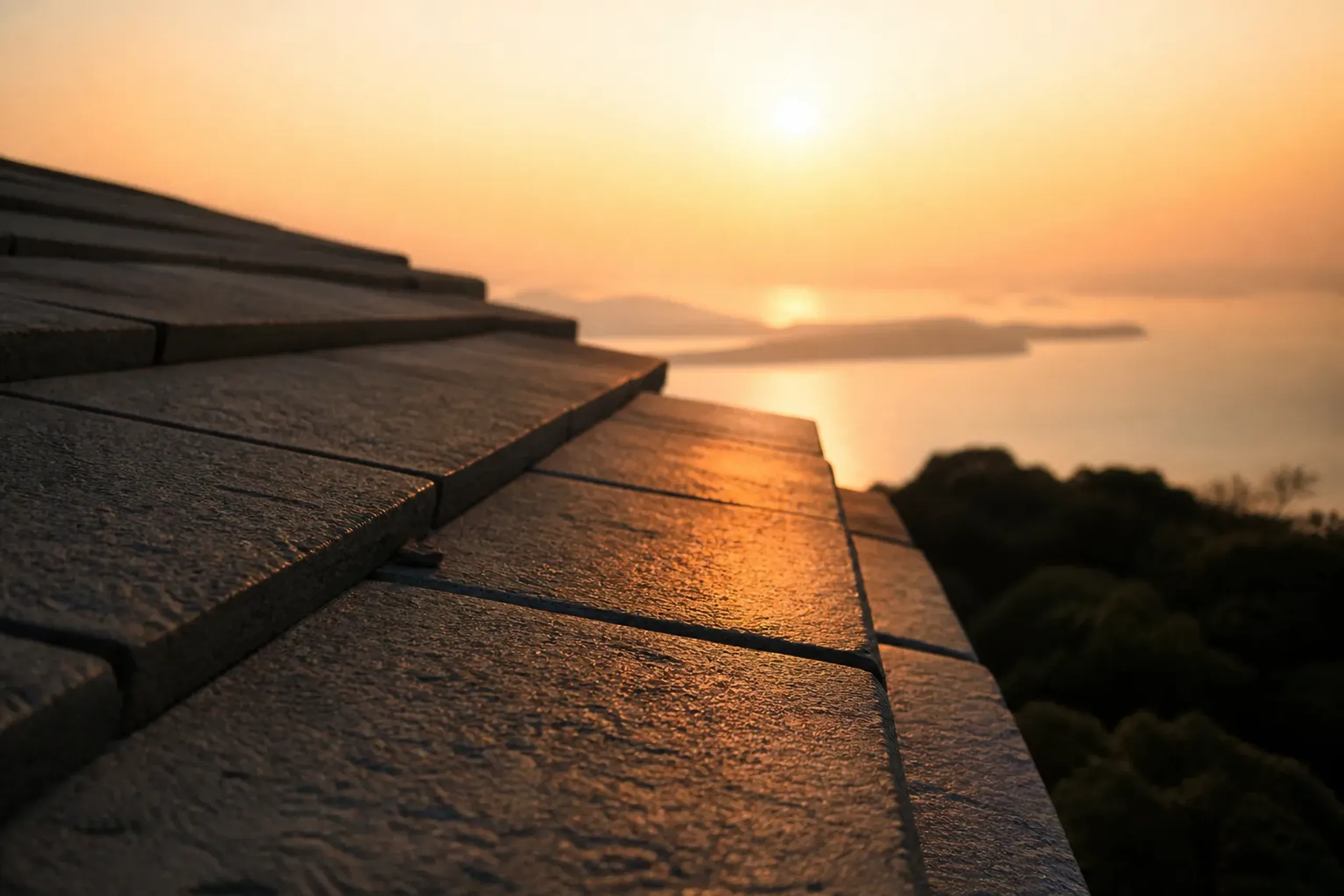
As the sun goes down, the roof changes with it. That single material choice ties the summit to the stone tradition of the region below; the connection is worth understanding, and the work of the Aji shokunin who cut it runs deeper than the roofline suggests.
Entry to the building is free. There is a café and a shop, and a panorama artwork on the Genpei War, shown for a separate charge, that runs the length of the interior wall. Standard hours are 9:00 to 17:00, extending to 21:00 on Fridays, Saturdays and days before public holidays. Crucially for this page, the building is available as a venue for events and receptions — and it is on that basis that a private evening there is arranged.
What JRS arranges
Japan Royal Service arranges booking across the plateau's sites, after-hours access to the building, and dinner, together with chauffeured transfer from the berth up the mountain and back. Where an evening use of Yashimaru is possible, the architecture and the panorama work can be interpreted for your party, and the history, geology and battle of Yashima given properly — the commentary is not delivered in English by default, so an interpreter is provided. The temple and the western lookout are seen beforehand. A tailor-made itinerary settles the shape of the evening around the day's actual sunset and the sailing window. It is stated here once, plainly, and handled discreetly thereafter: we do not publish our guests, our itineraries or our rates.
Hours, terrain and weather
These notes are specific and practical. Most guests will have no use for them; they are here because somebody will.
Timing moves with the season. Sunset over the Inland Sea shifts by roughly two hours across the year, so the shape of the evening changes with the month — the last light, the blue half-hour, the city coming on. Rather than fix a time that would be wrong for most of the calendar, the evening is built around the sunset of the actual day. This is exactly the sort of seasonal judgement worth leaning on: knowing what to experience, where, in which month.
The mountaintop. The car park on the summit operates 6:30 to 22:00. The plateau is walked between viewpoints on uneven paths; Shishi-no-Reigan lies about eight minutes on foot from the car park. Vehicles can be brought close to the building by prior application, which must be made in advance.
Weather. The plateau is exposed and coastal, and the view is the entire product. A clouded-out evening is a real possibility, and an alternative is built into every plan so that a poor sky does not leave the evening empty.
Confirm current Yashimaru hours and venue terms at the time of arranging; they are reviewed annually.
The daytime pairing at the foot
If the ship is in overnight and there is a daytime to fill before the evening ascent, the Shikoku Mura Museum sits at the foot of the plateau — an open-air museum of thirty-three relocated historic buildings, including Important Cultural Properties, a vine bridge, Aji stone works by Nagare Masayuki, and a gallery designed by Tadao Ando.
It closes at 17:00, with last entry at 16:30, and is shut on Tuesdays. It is a daytime proposition and does not belong in the evening plan; it is the natural daylight pairing for it. The plateau's own aquarium is closed for renovation and does not figure until it reopens.
An invitation
The evening on Yashima is not a stop; it is a reason to keep the ship at Takamatsu after dark. If that is the kind of night you would like built — the western rim at dusk, the roof of Aji stone changing colour, the city coming up beneath you — contact us here.